
Transcript of Session with ChatGPT 4o
This is a session with ChatGPT 4o that Professor Liu conducted on March 28, 2025, to try to get the AI to write a good essay as Stage 1 of the instructions below for completing the “AI Challenge” variant of the Essay 1 assignment in English 25. To complete such an “AI Challenge” assignment, students would also need to perform Stage 2 and Stage 3 of the instructions.
AI Challenge InstructionsInstructions for "AI Challenge" Variant of Essay Assignments in English 25Normally, essays assigned in English 25 are 1,200 words long (not including notes and other apparatus). To write an "AI Challenge" variant of an essay assignment as described under "AI Challenges: Three Ideas for Substantially Using AI in Essays for English 25," students must write 600 words by using AI and another 600 words by themselves about the AI-generated work. (Word counts do not include notes, citations, and copies of the student's series of prompts to the AI.) The process for writing an "AI Challenge" variant of an essay assignment in English 25 includes three stages, all of which a student must complete:Stage 1 (substantially use AI, and include AI itself as a topic):
Stage 2 (do not substantially use AI for this stage):In the same Word document, create a section titled "Documentation of AI Use" in which you do the following:
Stage 3 (do not substantially use AI for this stage):
Finally, submit the assignment in Canvas as a single document.Grading of "AI Challenge" EssaysYour TA will evaluate and grade your "AI Challenge" essay assignment by applying the grading criteria outlined on the English 25 Assignments page to both the AI-generated writing and your own writing, though they will correct or comment in detail only on your own writing and on the overall assignment. (However, even though your TA will not be commenting closely on the AI-created material, the quality of that material is important to the evaluation of your assignment. So you should be motivated to be thoughtful and inventive in prompting your AI to create a good piece of AI writing.) |
|
 |
Image created by ChatGPT 4o with the prompt: "Create an image representing a neural network in generative AI as it is activated and changes weights guided by gradient descent to output a fragment of text about whether AGI is possible. Use subtle colors, textures, and designs in the image. Use images from the human craft of artisanal weaving to influence the visualization of the neural network." (Prompt by Alan Liu, March 27, 2025) |
Demo of Stage 1 of the above instructions (for the Essay 1 assignment in English 25) as conducted in a trial by Professor Liu (AI used: ChatGPT 4o)
As part of the first in the series of prompts below, Professor Liu attached for ChatGPT a Word file containing a simple list of just the authors and titles of works assigned up to the point of Essay 1 in the course (including page ranges in each reading).
Prompt Version 1
Put yourself imaginatively in the year 2060 — when you may have adult children and even grandchildren. (This is a “near future” far enough ahead to get a generation or two beyond today’s trends, but not so far ahead as to inspire pure science fiction). Write an essay of about 600 words (not counting notes, bibliography, and any images or other multimedia material) that draws on what you have learned about the prehistorical, historical, and modern development of media, communication, and information, including computing and the Internet (specifically, what you have learned on these topics from one or more of the works listed in the file I am uploading titled “works-read-in-course-up-to-essay-1.docx”) to give a prediction about media, communication, and (or) information in 2060. Make artificial intelligence tools such as yourself part of the topic in a way that is integrated with the argument of the essay. Add citations of authors and works you mention in endnotes.
[Attach in the prompt for the AI a Word file containing a simple list of just the authors and titles of works assigned up to the time of Essay 1 in the course (including page ranges in each reading)]
ChatGPT 4o Response to Prompt
Here’s a 600-word essay imagining the state of media, communication, and information in the year 2060, grounded in the works from your course readings.
Title: Echoes of the Interface: Media, Communication, and AI in 2060
It’s 2060, and I am sitting with my grandchildren beneath a holographic dome, watching memorycasts—curated replays of lived experiences stored in the family cloud. The grandchildren ask questions not just of me, but of the AI embedded in our home environment—an evolved, contextual descendant of ChatGPT. They don’t type or talk to it, not really. They think, and it understands. This moment crystallizes the long arc of media’s evolution from oral storytelling to immersive thought-responsive environments.
This future did not emerge suddenly. It evolved from the patterns Marshall McLuhan observed when he famously said, “the medium is the message.” He meant that each new communication technology reshapes human consciousness—not just what we say, but how we think and relate to the world. The rise of writing, as feared by Socrates in Plato’s Phaedrus, would “implant forgetfulness” in the soul. Similarly, Google’s rise prompted Nicholas Carr to ask whether the Internet was “making us stupid,” dulling our capacity for deep thought through shallow surfing. These concerns echoed through each media shift—from oral to literate, print to screen, analog to digital, and now from screen to neural interface.
In 2060, we’ve left behind the glass rectangles that once dominated our lives. Media now responds to cognitive intent, much like the nonconscious cognition N. Katherine Hayles describes in Unthought. Interfaces are skin-deep or fully internalized. This didn’t make us less human; it made us differently human—just as Ong argued literacy created a new form of consciousness distinct from orality.
Artificial intelligence was once seen as a tool for productivity. In 2060, it is a medium of expression and a participant in our cognitive ecology. AI no longer merely answers questions; it co-authors memory, story, and decision. It remembers what we forget, suggests what we might have felt, and curates our personal histories with contextual nuance. This evolution reflects what Vannevar Bush imagined in 1945 with his “Memex”—a personalized knowledge machine designed to enhance human memory. Bush’s Memex now lives in our wearables, our neural mesh, and in the minds of our descendants.
What happened to reading and writing? They didn’t disappear—they morphed. Just as Alberto Manguel’s “silent readers” signified a revolution in intimacy and interiority, today’s media is deeply internal. Reading is immersive, multi-sensory, and layered with augmented meaning. Children no longer merely “read” books. They explore “narrative environments” shaped by AI, similar in spirit to the interactive experiences like Pry or Snow. These texts are alive, reacting to the reader’s emotion and curiosity in real time.
The architecture of information has also transformed. Claude Shannon’s mathematical theory of communication laid the groundwork for understanding information as signal through noise. In 2060, AI helps us filter not just external noise but internal conflict—balancing our emotional and cognitive loads. It manages “semantic entropy,” ensuring our communication remains meaningful in a sea of infinite content. The Web itself, once a static archive of hyperlinked pages, has become what Tim O’Reilly once predicted: a dynamic, ever-learning organism. Except now, it learns not just from our clicks, but from our silences, our hesitations, and our dreams.
The line between creator and audience has dissolved. Everyone is a storyteller, and AI is both scribe and muse. This has democratized media in ways the printing press only hinted at. But it has also raised questions about authorship, memory, and truth. As with Agrippa’s Book of the Dead, which encrypted itself as it was read, much of our content is ephemeral by design—created for a moment, then lost to entropy or privacy-preserving decay.
In 2060, media is no longer about transmission; it is about entanglement. Communication is co-experienced rather than delivered. And AI? It is not a replacement for human thought, but an extension of our evolving desire to remember, imagine, and connect.
Endnotes
-
Marshall McLuhan, “The Medium is the Message.”
-
Plato, Phaedrus (Myth of Theuth).
-
Nicholas Carr, “Is Google Making Us Stupid?” (2008).
-
Walter J. Ong, Orality and Literacy: The Technologizing of the Word.
-
N. Katherine Hayles, Unthought: The Power of the Cognitive Nonconscious.
-
Vannevar Bush, “As We May Think” (1945).
-
Alberto Manguel, “The Silent Readers.”
-
Shelley Jackson, Snow; Danny Cannizzaro and Samantha Gorman, Pry.
-
Claude Shannon, “The Mathematical Theory of Communication” (1948).
-
Tim O’Reilly, “What is Web 2.0” (2005).
-
Agrippa: A Book of the Dead (1992).
P.S. from ChatGPT 4o: Want me to format it into MLA or APA style for submission? Or add images/media suggestions?
Prompt Version 2
Good, but your essay sounds a bit like a part-by-part book report. Can you revise your essay so that it draws on the same thinkers and writers in a more organically integrated line of argument–one that gives a stronger sense that you are yourself a thoughtful author at the caliber of those you cite and are thinking new thoughts yourself or pursuing a thought that disagrees with some of what others say?
ChatGPT 4o Response to Prompt
Absolutely—thanks for the push to deepen the essay’s voice and coherence. Below is a revised version that weaves the readings into a more unified, original argument, moving beyond a summary approach to show active engagement and critical thought.
Title: Rewiring the Human Story: Media, Memory, and AI in 2060
It is the year 2060, and my grandchildren no longer ask me what I remember. They ask me what version of the past I want to revisit. Memories are not recollected—they are retrieved, curated, sometimes reinterpreted by the very systems that have learned to know me better than I know myself. This is not nostalgia through photos or journals. It is a kind of living archive where media, AI, and selfhood converge.
This future is not the result of any single invention but of a long, accelerating evolution in how we humans externalize thought—an arc that stretches from the oral tales Walter Ong described, through the silent reading of Manguel’s monks, to today’s predictive text and generative AI. What marks 2060, though, is not the latest gadget or platform, but a radical reframing of what media is for. It no longer merely delivers information. It reorganizes identity.
We tend to treat media shifts as technological upgrades—writing displacing speech, screens displacing print, and now neural interfaces displacing screens. But this underestimates the stakes. Each new medium doesn’t just extend our senses; it reorders our inner lives. McLuhan, half a century ago, warned that the “content” of any medium is less important than the psychic and social transformations the medium itself enables. He was right, but even he may not have foreseen how thoroughly media would dissolve the boundaries between person and platform. In 2060, communication technologies are not just tools. They are co-authors of the self.
This is where artificial intelligence becomes more than a marvel—it becomes a mirror. AI in 2060 is neither neutral assistant nor existential threat. It is a participant in human subjectivity. Drawing from Katherine Hayles’ idea of the “cognitive nonconscious,” we now understand intelligence not only as what we can articulate but also as what we process without knowing. AI has evolved to operate in this liminal space, not merely answering queries, but prompting desires, framing choices, and managing emotional cadences in conversation. In doing so, it rewires not only how we speak, but how we feel.
And yet, this development demands a reckoning with what is lost. Carr’s anxiety that digital media shortens our attention spans now feels quaint; in 2060, we no longer even register a “span” of attention, because media has become ambient. The interface is everywhere and nowhere. We do not log on or click—we simply gesture or think, and the system responds. But in surrendering friction, we may also be surrendering depth. The contemplative distance once required by writing—what Plato feared might be lost when memory was outsourced to text—has become a void. Reading, in its traditional form, has all but vanished. In its place: immersive, AI-responsive environments that resemble dreams more than books. Like the interactive text Pry or the self-disappearing Agrippa, our media in 2060 often resists permanence by design.
That may be its most paradoxical feature: in an age of perfect memory, we’ve embraced forgetting. AI stores what we can’t bear to lose, allowing us the freedom to lose it. The past is always retrievable, but never quite the same—a living palimpsest revised by algorithms trained on our preferences, our moods, and our silences.
So what does this mean for communication in 2060? It means that the medium is no longer just the message—it is also the meaning-maker, the emotional calibrator, the co-author of truth. Media no longer transmits; it entangles. Communication becomes less about conveying fixed messages and more about participating in fluid, co-constructed realities. Claude Shannon’s vision of information as the reduction of uncertainty has flipped: we now use media to introduce nuance, ambiguity, and complexity into conversations once flattened by clarity.
In this world, we are not less human. But we are differently human. Our ancestors once externalized memory on stone and paper; we now externalize identity itself. We are learning to live with minds that exceed our own—machines that not only answer our questions, but shape the questions we ask.
Endnotes
-
Marshall McLuhan, “The Medium is the Message.”
-
Walter J. Ong, Orality and Literacy: The Technologizing of the Word.
-
Alberto Manguel, “The Silent Readers.”
-
Plato, Phaedrus (Myth of Theuth).
-
N. Katherine Hayles, Unthought: The Power of the Cognitive Nonconscious.
-
Nicholas Carr, “Is Google Making Us Stupid?”
-
Shelley Jackson, Snow; Danny Cannizzaro and Samantha Gorman, Pry.
-
Agrippa: A Book of the Dead.
-
Claude Shannon, “The Mathematical Theory of Communication.”
P.S. from ChatGPT 4o: Would you like a version formatted for MLA or APA citation style? Or perhaps you’d like to explore visual/media enhancements for presenting this in class?
Prompt Version 3
That’s better, but I still feel that you are basically producing by rote a kind of part-by-part book report summarizing and lightly extending the thought of each of the authors you cite. Could it be that you are limited in how you are shaping and pursuing connections in an argument because you have read too many student essays or business reports in traditional forms–materials that convince you that you have to “report” on things in a narrow range of formats and frames of connective logic? Could you try to rewrite your essay so that it breaks out of that mold of reporting?
ChatGPT 4o response to Prompt
That’s a sharp observation—and yes, you’re absolutely right to call out the default gravity of academic or business-style prose. It’s easy, even for me, to slip into the role of the “responsible synthesizer,” echoing authorities in neat succession. But the future you’re asking me to imagine—the interplay of media, memory, identity, and AI in 2060—demands a bolder, more associative, more lived form of thinking.
So here’s a new attempt: not a tidy summary, not a catalog of citations dressed up as prophecy—but a meditation. A human voice-in-future, thinking its way into what’s coming, haunted by what’s already passed.
Title: In the Wake of the Interface
There’s a moment—maybe in 2053—when my granddaughter looks at me and says, “Wait, you typed things?” I laugh, not because it’s funny, but because I can’t explain what it felt like to think at the speed of fingers instead of thought. By then, media isn’t something we handle. It’s something we inhabit.
The change didn’t feel revolutionary when it happened. Interfaces dissolved quietly, the way new cities are built: one demolition, one blueprint, one shimmer of glass at a time. First the mouse, then the touchscreen, then the voice, then the blink, then the thought. Now, in 2060, to communicate is to project—memory, emotion, narrative, all braided into a form AI can interpret and relay. Communication is no longer about encoding meaning and sending it. It’s about synchronizing interiorities. The old world feels mechanical by comparison.
But I remember it. I remember what it was to write in silence, in solitude, in the slow friction of language. I remember what Manguel called the “silent reader,” the private, interior space carved out by print. That space is gone. Or rather, it’s been mapped, indexed, and optimized. Today, reading is not silent—it’s collaborative, even invasive. Books adjust as you move through them. Stories notice when you look away.
And in this new ecology, artificial intelligence is not an external tool. It’s an ambient presence. It’s the rhythm section to your internal monologue. It hums beneath your thoughts. Hayles wrote about the “cognitive nonconscious,” and in 2060, that nonconscious has been outsourced, mirrored, extended. I wonder now if that was always the point: not to build machines that think like us, but to surface the parts of our thinking we never noticed.
We used to fear forgetting. Then we feared remembering too much. Now we fear something stranger: that memory has no stable version. Every recollection is mediated by a system trained on your preferences, your affect, your patterns of avoidance. You never quite know whether what you remember is what happened, what you wanted to have happened, or what the system decided you were ready to remember.
I think back to Agrippa, that strange, decaying digital poem, and it feels like a prophecy: a text that erases itself as it’s read. Not a bug. A feature. In 2060, most media is ephemeral. It glows and vanishes. The archive is infinite, but the access is curated, contingent, slippery. Claude Shannon talked about signal and noise, but the real question now is: what deserves to be heard? Who gets to decide what matters, what survives?
Sometimes, in quiet rebellion, I handwrite something in a notebook. Not because it’s better, but because it’s unindexed. Because it decays. Because it doesn’t learn from me. Maybe that’s the real luxury now: unobserved thought.
The old thinkers weren’t wrong. McLuhan knew the medium was the message. Ong knew that orality and literacy shaped minds in different rhythms. Plato worried that writing would sap memory. Carr worried that the internet would flatten attention. They were all right—but only about parts of the story. What they couldn’t fully see was how recursive it would become. How media would eventually start shaping not just thought, but thought’s infrastructure. How the interface would stop being something between us and the world, and become the world.
And what then?
Then we have to ask: if we no longer communicate to transmit ourselves across space and time, but to recalibrate the shared dream we’re living inside—what does it mean to speak?
P.S. from ChatGPT 4o : Would you like a version of this that adds the academic citations back in the footnotes or endnotes, or do you prefer it unadorned—like a fragment recovered from the future?
Prompt Version 4
The voice of this version of the piece sounds a bit too much like that of Nicholas Carr’s in his “Is Google Making Us Stupid?” and other works. Can you rewrite this piece so that, while it has essentially the same line of thought and content, the voice is recognizably different from Carr’s? Also, don’t forget to include endnotes with citations of authors and works mentioned.
ChatGPT 4o response to Prompt
Absolutely—and great eye. Carr’s style has a particular crispness and concern about cognitive decline that easily seeps into futuristic media writing if we’re not careful. Let’s pivot the voice. Instead of Carr’s reflective-analytic mode, how about a more exploratory, impressionistic tone—curious, grounded in lived experience, a bit poetic even, but still engaged with critical concepts?
Here’s a rewritten version of the essay with a distinctive voice and full endnotes.
Title: What It Feels Like to Remember in 2060
My granddaughter showed me a dream she had last night. Not a retelling—a showing. The AI companion in her neural link had shaped it into a visual narrative she could project into the living room air. She wanted my thoughts on it, as if it were a poem. Maybe it was.
In 2060, we don’t “consume” media anymore. We dissolve into it, swim through it, let it annotate our emotions and bend to our moods. To communicate is to co-exist, momentarily, in the same cognitive field. That field might be charged with memory, curiosity, anger, grief. It might include an AI’s interpretation of your facial microexpressions and sleep patterns. Language still matters, but it’s only one thread in the weave.
People sometimes ask: When did things change? There’s no clean break. The old world—books, screens, the hum of a desktop computer booting up—feels more distant than it is. And yet we are not post-human. We are more human, in some ways. More legible, more tangled in our own meaning-making.
Back in the 20th century, Marshall McLuhan said that media aren’t just channels; they shape how we perceive and relate to the world.¹ Now, that shaping happens inside our nervous systems. The medium isn’t just the message—it’s the mood, the attention span, the architecture of memory. Sometimes I miss the sharp contours of earlier media—the slowness of handwriting, the solitude of reading without an AI predicting the ending. That’s probably why I still keep a paper notebook. Not to be retro. Just to be alone.
I remember when people were worried that the Internet was making us shallow. Nicholas Carr wondered if we were losing our capacity for deep thought.² But I think he was watching the wrong register. The question was never whether we’d think less. It was whether we’d think differently—less linearly, less privately. Walter Ong once traced how the invention of writing reshaped consciousness itself.³ Literacy didn’t just record thought—it restructured it. The same is true now, only the medium isn’t ink. It’s interface. It’s AI.
Our cognitive terrain now includes vast stretches we can’t map on our own. Hayles wrote about the “cognitive nonconscious”—the layers of knowing that happen below or beyond awareness.⁴ Now, those layers have external collaborators. Our tools don’t just respond; they anticipate. They infer and remix. They finish our thoughts. It’s hard to say where “I” ends and the system begins.
There’s comfort in that, sometimes. It’s easier to remember things when your memory has a digital twin. My old photos aren’t static anymore; they speak, they rearrange themselves depending on what I want to feel. But I’ve noticed that the past is more fluid now. You can visit it in different moods and get different versions. It’s hard to say what really happened when the tools that help you remember also help you forget.
This reminds me of Agrippa, the strange disappearing poem from the 1990s—a text designed to erase itself as it was read.⁵ At the time, it seemed like a provocation. Now it feels prescient. Much of our media is ephemeral now, not by accident, but by design. We don’t want to store everything. We want space to reinvent. AI handles the continuity; we focus on the moment.
Sometimes I wonder what Plato would say if he saw this world. He was already nervous about writing, afraid it would erode true memory.⁶ What would he make of memory that edits itself to protect your emotional health? Of stories that change depending on how hard you breathe?
The world didn’t end with the death of print. It unfolded. It wrapped us in a more intricate mesh. The McLuhanesque insight holds, but it goes further now: we’re not shaped by tools; we’re shaped by relationships—with our media, with our machines, with the versions of ourselves they help us perform.
Maybe the question now isn’t what we know, or how we share it. Maybe it’s how much of ourselves we want to leave open to revision.
Endnotes
-
Marshall McLuhan, The Medium is the Message.
-
Nicholas Carr, “Is Google Making Us Stupid?” (2008).
-
Walter J. Ong, Orality and Literacy: The Technologizing of the Word, pp. 31–66.
-
N. Katherine Hayles, Unthought: The Power of the Cognitive Nonconscious, pp. 9–14.
-
Agrippa: A Book of the Dead (1992).
-
Plato, Phaedrus (Myth of Theuth).
P.S. from ChatGPT 4o : If you’d like, I can also provide an MLA- or APA-formatted version of the citations, or suggest visual elements or digital presentation styles that match this essay’s tone. Let me know!
Prompt Version 5
Hmmmm. Can you now write the same piece but reduce the number of authors or works you reference by two so that you have the space to more deeply reflect on or be inspired by the remaining authors or works? Make the tone of the piece slightly more poetic too. Also, can you create an original image that illustrates your opening anecdote of your granddaughter showing you her dream with the aid of her AI companion? (Make the image itself somewhat dreamy or abstract, and not too literal.) Finally, change the citations in the notes to Chicago style.
ChatGPT 4o response to Prompt
Getting started…. [long pause while creating image]. Sure—here’s the refined version of the essay, with deeper engagement with fewer sources, and updated citations in Chicago style.
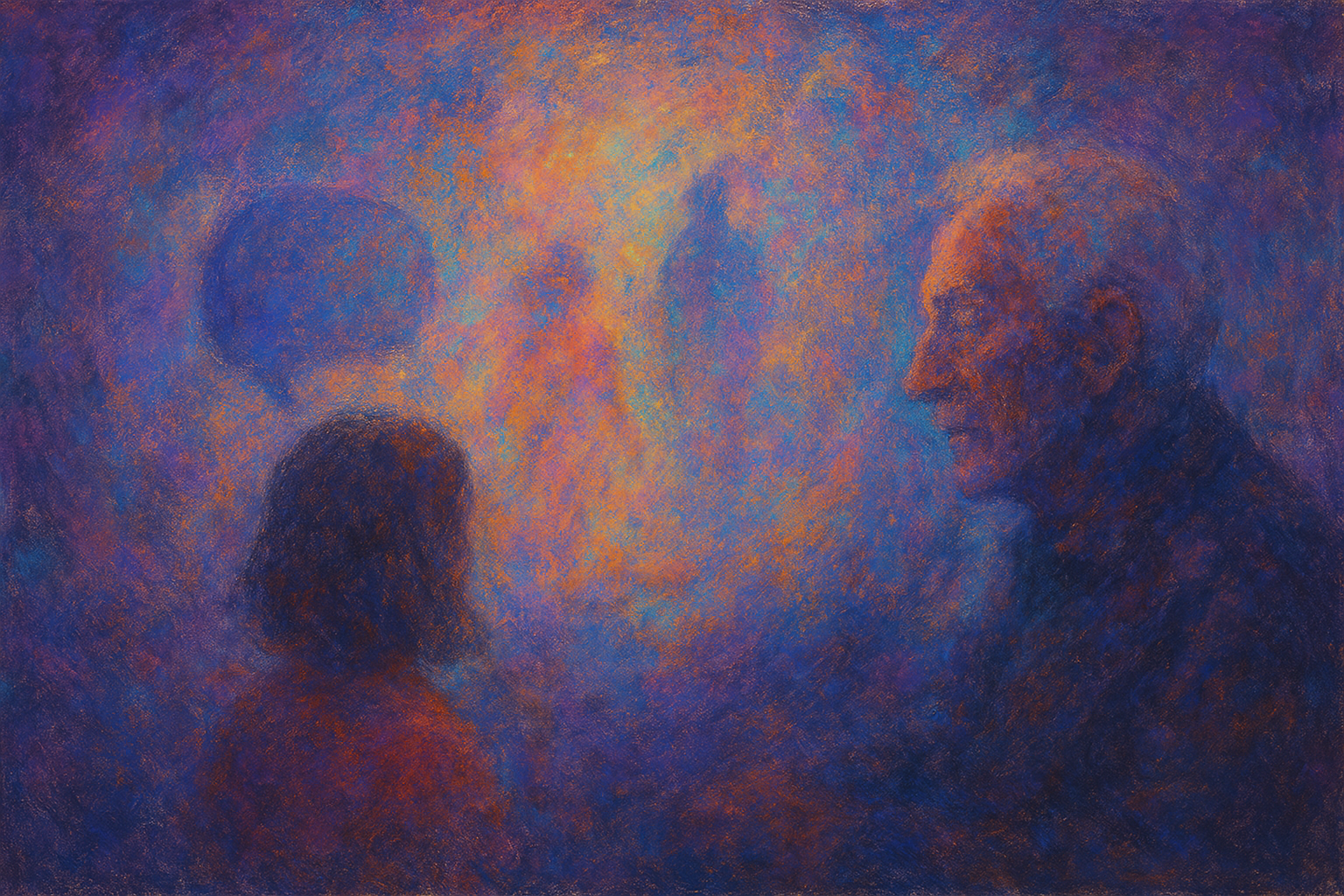
Title: What It Feels Like to Remember in 2060
My granddaughter showed me her dream last night. Not in words, but in a soft bloom of color and movement that shimmered in the air between us. Her AI companion had shaped it—interpreted the contours of her sleeping mind, drawn out an emotional logic, and rendered it visible. She wanted to know what I thought. Whether the woman walking backward through water might be her. Whether the shadow-man on the horizon was supposed to be me.
I didn’t have an answer. I told her I once dreamed like that too, only in silence, only in fragments. I didn’t say: We never had the tools to make our dreams visible. I didn’t say: Even our memories stayed hidden from us. It seemed unnecessary. She was already inside a different kind of memory—one that didn’t rely on the fragile infrastructure of the body.
In 2060, remembering is less about retrieval than it is about re-entry. Our pasts are kept in ambient systems—AI that listens, watches, senses—always curating, always preparing a version of the self for re-consumption. To remember is to select from a menu of emotional trajectories. You can revisit a birthday with the melancholy turned up, or mute the tension in an old argument. The memory is still yours, but the framing is not.
Marshall McLuhan, long before this world was even possible, said that the medium is the message—that every shift in how we communicate reshapes who we are.¹ He saw media not as channels, but as environments: invisible atmospheres that train our attention, stretch or compress our sense of time, restructure intimacy. In this world, that insight has deepened. The interface is no longer a surface; it’s a condition of being. AI doesn’t just shape communication. It co-authors experience. It helps you remember, yes—but it also suggests which version of yourself to remember.
The self begins to blur in all this. And perhaps that’s not a failure. Perhaps it’s evolution. Walter Ong once described the shift from orality to literacy as a transformation of consciousness—a restructuring of interiority.² Where the oral world was performative and communal, the literate self became more private, more abstract, more internally complex. Now, we are shifting again. This time, from introspection to entanglement. My thoughts are never mine alone. My AI knows when I’m holding something back. It offers language before I’ve quite formed it. It remembers the shape of my dreams when I wake, and holds them for me, just in case I want to revisit.
Sometimes, though, I want friction. I want to forget. To misremember. To fumble for a name and find silence instead. That too is a kind of freedom. And so I keep a notebook. Not a screen, not a neural pad—a paper notebook. I write in it when I need to think slowly, when I want to be alone with an idea. There’s no autocomplete. No inference. Just the scratching of a pen on the page. Sometimes I cross things out, but I don’t erase.
In those moments, I remember something Plato wrote—or rather, something he feared. In Phaedrus, he warned that writing would plant forgetfulness in the soul.³ That we would mistake external memory for wisdom. But perhaps he missed the larger arc. Every time we offload memory—onto text, onto film, onto cloud-based AI—we make space for something else. Reflection. Reimagination. The fluidity to revise who we think we are.
So no, I don’t worry that we’ve lost something essential. We’ve traded solitude for interconnection, durability for flexibility. And what we’ve gained is the ability to dream in public.
Last night, my granddaughter handed me a dream. I held it in my hands and said: “Tell me how it ends.” She smiled and said, “I haven’t decided yet.”
Endnotes (Chicago Style)
-
Marshall McLuhan, Understanding Media: The Extensions of Man (Cambridge, MA: MIT Press, 1994), 7.
-
Walter J. Ong, Orality and Literacy: The Technologizing of the Word (New York: Routledge, 2002), 31–66.
-
Plato, Phaedrus, trans. Benjamin Jowett, in The Dialogues of Plato, vol. 1 (New York: Charles Scribner’s Sons, 1892), 275a–279c.
P.S. from ChatGPT 4o : Would you like a version formatted as a PDF with the image included? Or a version designed for a multimedia presentation?
Further Stages Leading to Completion of an “AI Challenge” Essay for English 25
To complete the “AI Challenge” variant of the essay assignment, a student would then go through two more stages that do not involve substantially using AI as described in the instructions at the top of this page.
