
Class Business
- Upcoming Readings
-
- For Tuesday
- Stephen P. Borgatti, et al. (2009), “Network Analysis in the Social Sciences”

 alternative source: pre-copyedited manuscript of the article
- Elijah Meeks and Scott B. Weingart, “Introduction to Network Analysis and Representation” — click on the tabs for “centrality, ” “clustering coefficient,” etc. for brief interactive tutorials
- Stephen P. Borgatti, et al. (2009), “Network Analysis in the Social Sciences”
- For Next Thursday
- Paola Pascual-Ferrá, Neil Alperstein, and Daniel J. Barnett, “Social Network Analysis of COVID-19 Public Discourse on Twitter: Implications for Risk Communication” (2020)
- Richard Jean So and Hoyt Long, “Network Analysis and the Sociology of Modernism” (2013) — read only pp. 147-149, 158-166
- For Tuesday
-
- Practicum 7 due Tuesday, March 11th: Social Network Analysis Exercise (Part A)
-
~~ Neural Networks & Large Language Models ~~ (continued)
Human?
Minh Hua and Rita Raley, “Playing With Unicorns: AI Dungeon and Citizen NLP” (2020)
If a complete mode of understanding is as-yet unachievable, then evaluation is the next best thing…. (link)
In this endeavor, the General Language Understanding Evaluation benchmark (GLUE), a widely-adopted collection of nine datasets designed to assess a language model’s skills on elementary language operations, remains the standard for the evaluation of GPT-2 and similar transfer learning models…. Especially striking, and central to our analysis, are two points: a model’s performance on GLUE is binary (it either succeeds in the task or it does not)…. But if the training corpus is not univocal — if there is no single voice or style, which is to say no single benchmark — because of its massive size, it is as yet unclear how best to score the model. (link)
Our research questions, then, are these: by what means, with what critical toolbox or with which metrics, can AID [AI Dungeon], as a paradigmatic computational artifact, be qualitatively assessed, and which communities of evaluators ought to be involved in the process? (link)
AID, as an experiment with GPT-2, provides a model for how humanists might more meaningfully and synergistically contribute to the project of qualitative assessment going forward…. (link)
Our presupposition … is that it is not by itself sufficient to bring to bear on the textual output of a machine learning system the apparatus of critical judgment as it has been honed over centuries in relation to language art as a putatively human practice. What is striking even now is the extent to which humanistic evaluation in the domain of language generation is situated as a Turing decision: bot or not. (link)


Bot or bot? (ChatGPT)
Knowledge?

Plato, Phaedrus
O most ingenious Theuth, the parent or inventor of an art is not always the best judge of the utility or inutility of his own inventions…. [F]or this discovery of yours will create forgetfulness in the learners’ souls, because they will not use their memories. They will trust to the external written characters and not remember of themselves. The specific which you have discovered is an aid not to memory, but to reminiscence, and you give your disciples not truth, but only the semblance of truth; they will be hearers of many things and will have learned nothing; they will appear to be omniscient and will generally know nothing; they will be tiresome company, having the show of wisdom without the reality.


Emily M. Bender, Timnit Gebru et al., “On the Dangers of Stochastic Parrots: Can Language Models Be Too Big?” (2021)
Where traditional n-gram LMs can only model relatively local dependencies, predicting each word given the preceding sequence of N words (usually 5 or fewer), the Transformer LMs capture much larger windows and can produce text that is seemingly not only fluent but also coherent even over paragraphs….
We say seemingly coherent because coherence is in fact in the eye of the beholder. Our human understanding of coherence derives from our ability to recognize interlocutors’ beliefs and intentions within context. That is, human language use takes place between individuals who share common ground and are mutually aware of that sharing (and its extent), who have communicative intents which they use language to convey, and who model each others’ mental states as they communicate. As such, human communication relies on the interpretation of implicit meaning conveyed between individuals….
It must follow that even when we don’t know the person who generated the language we are interpreting, we build a partial model of who they are and what common ground we think they share with us, and use this in interpreting their words.
____Text generated by an LM is not grounded in communicative intent, any model of the world, or any model of the reader’s state of mind. It can’t have been, because the training data never included sharing thoughts with a listener, nor does the machine have the ability to do that. (Author, 616)
- IBM, “What is Explainable AI?” (n. d.)
 (Explainability versus interpretability in AI)
- Anthropic. “Decomposing Language Models Into Understandable Components,” 2024.
- Anthropic. “Mapping the Mind of a Large Language Model,” 2024.
Is AI Dungeon coherent?
Creative?
Epigraphs to Frame the Discussion
- Harold Cohen’s “Aaron”(1972-2010s)
- Whitney Museum of American Art
- Artnet
- Video about Harold Cohen & Aaron (see video at 4:45 for Aaron in action)
- Douglass Bakkum, Philip Gamblen, Guy Ben-Ary, Zenas Chao, and Steve Potter, “MEART: The Semi-Living Artist” (2007).
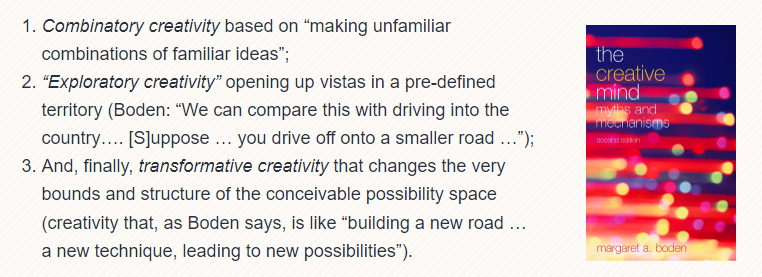
- Margaret A. Boden, The Creative Mind: Myths and Mechanisms, 2nd ed. (1990/2004) (PDF)
Practicum 6: Large Language Models & Text-to-Image Models Exercise
- CFP: NeurIPS Creative AI Track: Ambiguity
- Qiu, Weihao, and George Legrady. “Fencing Hallucination: An Interactive Installation for Fencing with AI and Synthesizing Chronophotographs.” In Extended Abstracts of the 2023 CHI Conference on Human Factors in Computing Systems, 1–5. CHI EA ’23. New York, NY, USA: Association for Computing Machinery, 2023.
Other Questions
 Functional or not?
Educational or not?
Fun or not?
Ethicaly or not?
Emily M. Bender, Timnit Gebru et al., “On the Dangers of Stochastic Parrots: Can Language Models Be Too Big?” (2021)
In this paper, we take a step back and ask: How big is too big? What are the possible risks associated with this technology and what paths are available for mitigating those risks? (abtract)
-
- Environmental & Financial Cost (sect. 3)
- Unfathomable Training Data (sect. 4)
- Overrepresentation of dominant voices (4.1)
- Filtering out of marginalized voices (4.2)
- Encoding bias (4.3)
- “Documentation debt” (4.4)
- Opportunity cost (wasting research on wrong aims) (sect. 5)
- Illusion of coherent meaning and communication (sect. 6)
The ersatz fluency and coherence of LMs raises several risks, precisely because humans are prepared to interpret strings belonging to languages they speak as meaningful and corresponding to the communicative intent of some individual or group of individuals who have accountability for what is said. (sect. 6.2)
