Alan Liu,
Visit to William Warner's English
147MC— Winter
2004
(Last revised
3/2/04
)
"New"
Elementary Principles of Communications
and Media Underlying the Internet
Binary Digital Code
("bits")
Digitization (sampling/quantification)
Binary number system (Claude
Shannon, George Boole, telecom
and transistor switching
technology)
Client/Server
Packetization
Metaphors for the
Elementary Principles
Steven Johnson, Interface
Culture: How New Technology
Transforms the Way We Create
and Communicate (San
Francisco: HarperEdge/HarperCollins,
1997), pp. 14-15:
A computer that does nothing
but manipulate sequences of
zeroes and ones is nothing
but an exceptionally inefficient
adding machine. For the magic
of the digital revolution
to take place, a computer
must also represent itself
to the user, in a language
that the user understands.
In this sense, the term computer
is something of a misnomer,
since the real innovation
here is not simply the capacity
for numerical calculation.
. . . The crucial technological
breakthrough lies instead
with this idea of the computer
as a symbolic system, a machine
that traffics in representations
or signs. . . . A computer
. . . is a symbolic system
from the ground up. Those
pulses of electricity are
symbols that stand in for
zeroes and ones, which in
turn represent simple mathematical
instruction sets, which in
turn represent words or images,
spreadsheets or e-mail messages.
The enormous power of the
modern digital computer depends
on this capacity for self-representation.
More often than not, this
representation takes the form
of a metaphor. . . . These
metaphors are the core idiom
of the contemporary graphic
interface.
In the age of the network, a computer
is not a calculating machine. So what
is it? (cf., the rhetorical device of
"catachresis")
Some ad hoc metaphors for the new elementary
principles of computing:
Bill Gates, The Road Ahead:
"[Charles Babbage] lacked the terms
we now use to refer to the parts of
his machine. He called the central processor . . .
the 'mill.' He referred to his machine's
memory as the 'store.' Babbage imagined
information being transformed the way
cotton was—drawn from a store
(warehouse) and milled into something
new." (p. 22)
"King
Shirham of India was so pleased when
one of his ministers invented the game
of chess that he asked the man to name
any reward.
'Your majesty,' said the minister, 'I
ask that you give me one grain of wheat
for the first square of the chessboard,
two grains for the second, four grains
for the third, and so on. . . ."
(pp. 32-33)
Alan Liu, Ultrabasic Guide to
the Internet for Humanities Users at
UCSB (1994) [excerpt]
Macro-Level Metaphors
for the Internet: Toward a Politics, Economics,
and Philosophy of Cyberspace
Larger implications of the
"client-server" principle
(itself a metaphor)
Important metaphors for the Internet:
Military
Original ARPAnet Paradigm
decentered communications
but command-and-control?
Non-Profit and
Educational
"Community"
early BBS's like The
Well. (See Howard Rheingold,
The Virtual Community:
Homesteading on the
Electronic Frontier.
New York: HarperCollins,
1994. <http://www.rheingold.com/vc/book/>)
civil society social
cause organizations
using "store-and-forward"
technologies like e-mail,
Usenet, Bitnet, Fidonet.
(See François
Fortier, Civil Society
Computer Networks: The
Perilous Road of Cyber-politics.
Diss. York University,
Toronto, 1996. <http://www.yorku.ca/research/dkproj/fortier/>)
computer-mediated
communications paradigm
(CMC). (See Steven Jones,
ed., Cybersociety:
Computer-Mediated Communication
and Community. Thousand
Oaks, Calif.: Sage,
1995)
Representative umbrella
organizations devoted to
wiring NGO movements around
the world:
Institute
for Global Communications
(IGC): ("About")
began in the U.S. in
1987 and now includes
under its umbrella PeaceNet,
EcoNet, WomensNet, Anti-RacismNet
(as well as LaborNet
from 1992-1999), and
such affiliated groups
as GreenNet in the UK.
Online networks that
arose in 1999-2000 and
after specifically to
organize protest at
the meetings of the
World Trade Organization
(e.g., in Seattle and
Washington, D.C.) and
the U.S. Democratic
and Republican presidential
conventions (in Los
Angeles and Philadelphia).
E.g., D2KLA,
the Direct Action Network,
Mobilization
for Global Justice,
and the Philadelphia
Direct Action Group
together with city-based
"indy media"
centers focused on these
occasions (e.g., the
Seattle, Washington
D.C., and Los Angeles
Independent Media Centers).
"Frontier"
(cf., "sea," "navigator,"
"explorer")
Famous cyberlibertarian
spokesmen ("digerati"):
Stewart Brand
(founder of The Whole
Earth Catalog and
The Well, reputed to
be the originator of
the statement "information
wants to be free")
Kevin Kelley
(Wired Magazine
editor)
John Perry Barlow
(former lyricist for
the Grateful Dead; co-founder
of the Electronic Frontier
Foundation) ("A
Declaration of the Independence
of Cyberspace,""The
Economy of Ideas")
("In China, Germany,
France, Russia, Singapore,
Italy and the United
States, you are trying
to ward off the virus
of liberty by erecting
guard posts at the frontiers
of Cyberspace.")
Jon Katz (journalist
covering the cyber-beat
for Wired,New
York Times, Rolling
Stone, etc.) ("Birth
of a Digital Nation")
George Gilder
("futurist"
associated with the
new right, the Progress
& Freedom Foundation,
the Discovery Institute)
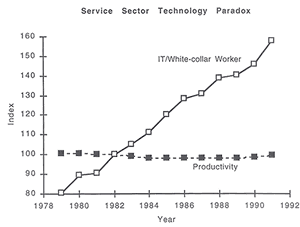
IT
capital
and
productivity
in
the
service
sector.
Data
from
Stephen
S.
Roach,
Technology
Imperatives;
chart
from
Thomas
K.
Landauer,
The
Trouble
with
Computers,
p.
31
Thomas K. Landauer,
The Trouble with
Computers: Usefulness,
Usability, and Productivity
(Cambridge, Mass.:
MIT Press, 1995)
Stephen S. Roach,
Technology Imperatives
(New York: Morgan
Stanley, 1992)
Paul A. Strassman,
Information Payoff:
The Transformation
of Work in the Electronic
Age (New York:
Free Press / Macmillan,
1985)
The "Virtual Corporation"
William H. Davidow and Michael S.
Malone. The Virtual Corporation:
Structuring and Revitalizing the Corporation
for the 21st Century. New York:
HarperCollins, 1992.
Don Tapscott, The Digital Economy:
Promise and Peril in the Age of Networked
Intelligence. New York: McGraw-Hill,
1996.