from Chapter 8:
Overview of the Internet
"Capsule History"
of the Internet, pp. 47-48:
The Internet is the global "network of networks"
or meta-network that currently links over 2,217,000
host or server computers around the world via hardwire,
satellite, and other communication channels. Most of
these nodes serve multiple, local computers.
Initiated in 1969 with just four nodes (at UCLA, Stanford,
University of Utah, and UCSB), the Internet-- then known
as ARPAnet-- was originally developed under Pentagon
sponsorship in part to sustain U. S. computer connectivity
in the event of a nuclear strike. The design specifications
called for it to connect point A to Z over just about
any mismatched assortment of intervening hardware and
software routes; and to do so flexibly such that the
destruction of some routes would not block data getting
through by other means. In the beginning, that is, the
Internet was what contemporary cinema calls "post-apocalypse."
It was the information highway for the road warrior.
How to ensure connectivity amid the hypothetical rubble?
The elegant savagery of the solution parallels "a
thousand plateaus," "lines of flight,"
"multiplicities," "schizophrenia,"
"packs," "many wolves," "bodies
without organs," and all the rest of the screaming,
postmodern philosophical horde. The solution lay in
"packet-switching." In packet-switched
data transmission (later standardized in the TCP/IP
protocol that is the circulatory system of the present
Internet), messages are broken up into discrete "packets"
each prefaced by a header identifying its origin, destination,
and sequential position in the overall message. Then
the packets are released like a flock of carrier pigeons
to find their own way across a patchwork of nodes each
of which assigns routing directions "on the fly."
(As it were: "Weather advisory: heavy network traffic
in the north; fly south." Or again: "nuclear
strike in Chicago; go through Dallas.") To stay
with the metaphor: some packets fly north, some south;
some make a beeline, some get tired and rest for a while.
But in the end (usually), all arrive at the destination
and are reassembled in their original order.
As evidenced by the logarithmic increase in nodes,
users, and uses during the '70's and '80's, the Internet
concept was highly successful-- so successful, indeed,
that it rapidly outgrew its original military framework
(a separate military MILnet split off in 1983). In 1989,
the National Science Foundation (NSF) took over sponsorship
of the Internet and initiated a series of bandwidth
and speed upgrades to the national linkway or "backbone."
Participation by educational, government, and other
such institutions was subsidized on the understanding
(formalized in an AUP or Accepted Use Policy)
that the Internet could not be used for commercial purposes.
By the 1990's, however, the business world wanted in
as well. Much of the current story of the Internet,
therefore, has to do not only with its outreach to such
previously underconnected portions of the research-and-education
community as humanities departments and undergraduates
but with the creation of CIX, CommerceNet, MecklerWeb,
and other commercial extensions of the Net. These "net
profit" universes, as it were, are hard at work
trying to adapt the decentralized, "many to many"
pragmatics of the Net (see below) to the traditional
"one to many" structures of mass-marketing
(and vice versa). Such mainstreaming has been paralleled
by a frenzy of Internet coverage in newspapers, TV,
and other conventional one-to-many broadcast media.
As witnessed in the salacious opportunism of the 1994
Los Angeles Times "scoop" on pornographic
graphics files secreted in a publicly-funded research
computer, or again--with a different kind of lust --
in the recent, wall-to-wall press coverage of telecommunication
and cable company mergers promising the proverbial "500
channels of on- demand entertainment," the one-to-many
media does not yet know quite what to make of the legitimacy
of many-to-many networking. Either the Net is all pornography
or it is the corporate promised land.
As of 1994, the NSF is officially ceding Internet sponsorship
to the private sector and retiring its no-commercial-use
rule. Concommitantly, therefore, the Internet has suddenly
begun to worry about such prerequisites for doing business
online as "authentication," "encryption,"
and "pricing structure."
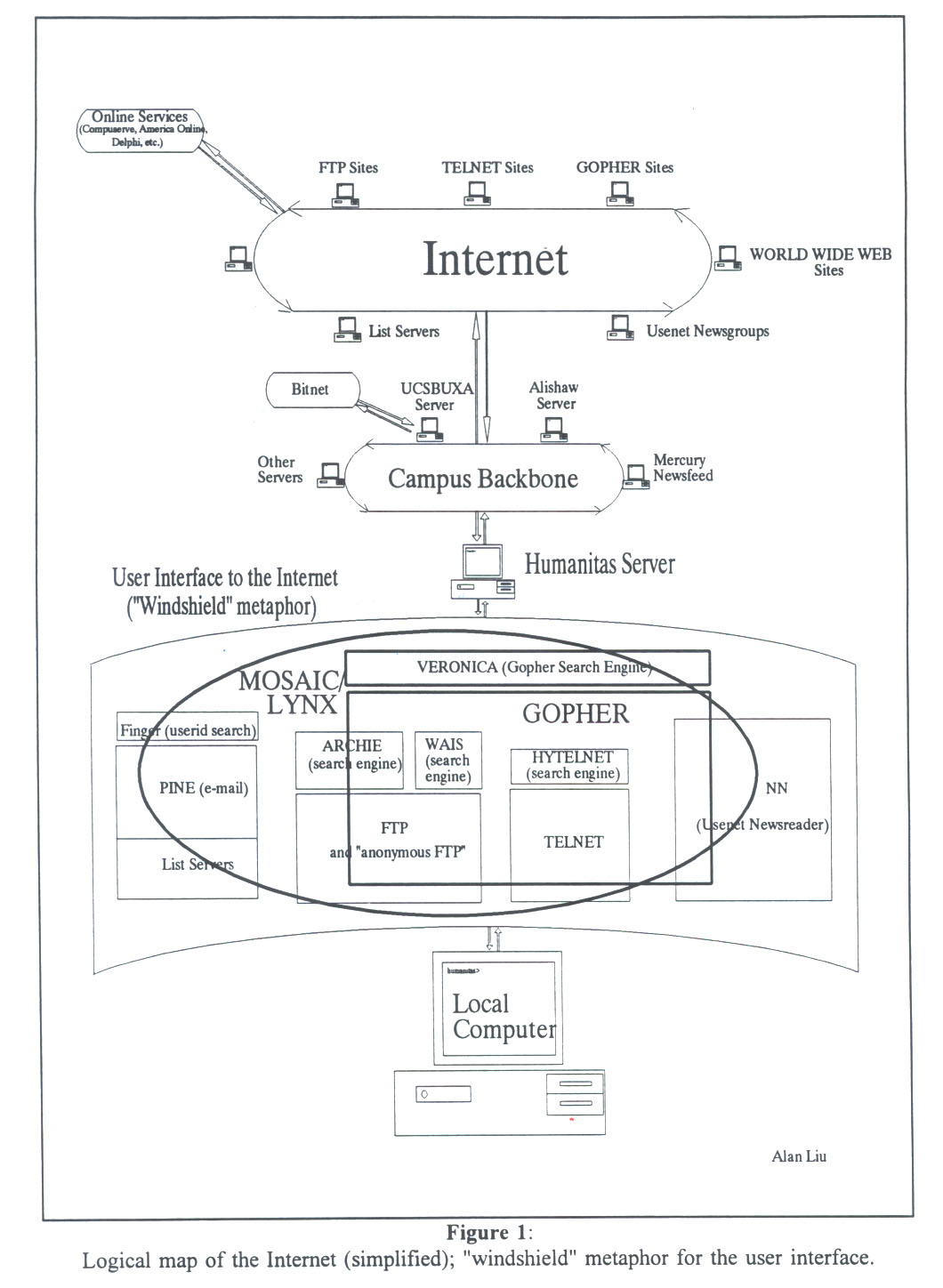
Figure 1: Logical Map of the
Internet (simplified), p. 52:
(click on image for larger version)
|