Humanities and Arts in the Age of 'Creative Destruction'

Author's Note This paper was put online for the NASSR conference panel on "Historical Knowledge, Social Agency, and Literary Value: 1800/2000" (Seattle, Aug. 17, 2001). It assembles together two pieces from my The Laws of Cool: The Culture of Information (forthcoming from Stanford Univ. Press). The first piece is the introductory chapter to the book; the second is an excerpt from a chapter on postindustrial business. Together, these pieces discuss the function of historical knowledge and literary value circa 2000 (with references back to the French Revolutionary period). There is no central concern with Romanticism. (In other words, I focus on the latter part of the dateline "1800/2000" in the title of this NASSR panel.) Readers may be interested in a related discussion
of contemporary historical knowledge in the conclusion to my book,
which was Webcast as a talk in June 2001. The talk may be heard
in Realmedia format at http://www.nyu.edu/its/humanities/ach_allc2001/its‑ach3.ram
|
||||
Chapter 1: Literature and Creative Destruction

¶1 This
book is a study of the cultural life of information or, more broadly,
of contemporary "knowledge work." The specific question I prepare
for–but that I can address here only speculatively in my initial
and concluding chapters–concerns the role of literature in that cultural
life. What is the future of literature and literary study when all culture
is increasingly the culture of information and when even literary scholars
subordinate literature to an apparent clone of information: cultural context?
To open the aperture more widely, what is the future of the "humanities
and fine arts" when humanities seems destined only for what the corporations
call human resources and fine arts for multimedia entertainment?
¶2 Or
to be honest, my concern is not really with literature as such, which
for knowledge workers has effectively lost its category distinction on
the gradient that blurs together textuality and information, imagination
and entertainment, authors and celebrities, and publishers and conglomerates.
My concern, more crucially, is with the underlying sense of the literary
that is even now searching for a new idiom and role. After all, whether
we should elegize or celebrate "the death of literature" (as
in Harold Bloom's The Western Canon or John Beverley's Against
Literature, respectively) is now beside the point.
[1] Literature as traditionally understood no longer survives as
an autonomous force or, put in the cultural-critical terms of the current
academy, as a force positioned by larger forces in the guise of autonomy.
Since the high point of its avowed self-possession (roughly from the eighteenth
through the nineteenth centuries), literature has merged with mass-market,
media, educational, political, and other institutions that reallocate,
repackage, and otherwise "repurpose" its assets. Such churning
of literary capital has only accelerated in the information age as major
institutions compete to appropriate that capital under the spotlight of
media coverage (e.g., the canon wars pitting political pundits against
academics).
¶3 But
all that is done, and we need harbor no false romanticism about the literature
that was. Whatever one thinks of cultural criticism, it has been brutally
effective in demonstrating that the churning of literary capital has always
characterized literature. Literature could not have been part of the
life of culture otherwise. What is of interest now is the distinctive
form of that churning in relation to the general economic and social churning
that Joseph A. Schumpeter (in his classic phrase about capitalism) called
"creative destruction." A "perennial gale of creative
destruction," Schumpeter wrote in 1942, "incessantly revolutionizes
the economic structure from within, incessantly destroying the
old one, incessantly creating a new one."
[2] The real competition, Schumpeter thus said, is not the normal
furor over prices, quality, and sales effort but "competition from
the new commodity, the new technology, the new source of supply, the new
type of organization . . . [competition] which strikes
not at the margins of the profits and the outputs of the existing firms
but at their foundations and their very lives."
[3] Recent business consultants and scholars take such furious creativity
to be simply postindustrial business as usual. In "post-capitalist
society," Peter F. Drucker says, "creative destruction"
is "innovation" compelling the "systematic abandonment
of the established, the customary, the familiar, the comfortable. . . ."
The "spirit of informationalism," Manuel Castells adds, "is
the culture of 'creative destruction' accelerated to the speed of the
optoelectronic circuits that process its signals."
[4]
¶4 The vital task for both literature and literary study in the age of advanced creative destruction, I believe, is to inquire into the aesthetic value—let us simply call it the literary—once managed by "creative" literature but now busily seeking new management amid the ceaseless creation and recreation of the forms, styles, media, and institutions of postindustrial knowledge work. In the regime of systematic innovation, is the very notion of the literary doomed to extinction even if—or, rather, especially if—it begins to venture "creatively" into the province of knowledge work, if it dares to imagine a literature of the database, spreadsheet, report, and Web page? After all, next to the great, institutional documents of our times heralding "innovation" in their very logos—all the legions of dot.company prospectuses, Web sites, advertisements, and so on—what could literature be but a minor creativity like a screensaver? This is one way to read the powerful, repeated dirge that John Guillory, Alvin Kernan, J. Hillis Miller, and others have sounded over (in Guillory=s words in Cultural Capital) the "perceived decline in the cultural significance of literature itself, the perceived marginality of literary culture to the modern social order." [5] In such wakes, there is an excessive mourning not so much for literature as for the "literary culture" that is the very possibility of literature. Or if literariness is to rise from the dead—to entertain Guillory's concluding prophetic-elegy, his surprising surmise of a redemptive "aestheticism unbound"—where could it go and what does it yet have to do? (Cultural Capital, p. 340) [6] What is the future of the literary when the true aestheticism unbound of knowledge work—as seen on innumerable Web pages—is "cool"? Cool is the techno-informatic vanishing point of contemporary aesthetics, psychology, morality, politics, spirituality, and everything. No more beauty, sublimity, tragedy, grace, or evil; only cool or not cool.
¶5 Or rather, since the fate of the literary is an abstraction unless we also address the fate of literary people, the operative question becomes: what is the relation between the now predominantly academic and other knowledge workers (including "creative writers") who manage literary value in "cultural context" and the broader realm of professional, managerial, and technical knowledge workers who manage information value in "systems"? What do the well-read who once held power in the name of the aesthetic still have to teach the well-informed who now hold power under the cover of cool? [7]
¶6 As
may be discerned in the conflicted way I have so far invoked cultural
criticism, the above questions are interwoven for me with questions about
what role that method—and the contemporary humanities education it represents—might
play in the emergence of the future literary. I was one of the academic
intellectuals in the 1980s and 1990s who staked their careers on joining
literary studies at the hip to cultural studies. [8] But now it is time to reflect
on the legitimacy of cultural criticism in ways that shift earlier controversies
about cultural materialism, the New Historicism, multiculturalism, and
so on to new ground.
¶7 It
might be said with Kafkaesque irony: I went to sleep one day a cultural
critic and woke the next metamorphosed into a data processor. It is not
just that cultural context and information have come to approximate each
other in their gross anatomy (each requiring the same kind of gathering,
collating, and filtering work); it is that now even the fine structure
seems to mate. We can extend to informationalism Arif Dirlik's general
point about postindustrialism in his "The Postmodernization of Production
and Its Organization."
[9] In a convergence so massive as to be all but indiscernible in
normal academic practice, advanced literary study has since the 1970s
evolved from structuralism through deconstruction to cultural/multicultural
criticism so as to swing into conjunction with an information society
that meanwhile evolved in parallel from logocentric corporations and broadcast
empires to the postindustrial equivalents of cultural diversity: flexible-team
corporations and distributed information networks. To put it rudely,
in other words, perhaps the academic controversies of the past two decades
were not really about supplanting the author or canon with the deconstructive
intertext or cultural context. Perhaps such controversies were really
about recruiting professional interpreters for an impending mental merger
with the software-telecom-cable-Hollywood conglomerates now promising
that ultimate intertext or context: high-bandwidth information.
¶8 After all, any cultural critic who today uses a personal computer to write "files" about literature is from the first incorporated within an information culture closest to hand in the very operating system. [10] As it were: the well-known epilogue to Stephen Greenblatt's paradigm of New Historicist criticism, Renaissance Self-Fashioning, needs to be updated. To reshoot for the 2000s the scene in which Greenblatt reads Clifford Geertz's Interpretation of Cultures while sitting on a plane with a man whose son is grievously ill would require that our camera pull back to reveal the device that all the corporate intelligentsia up and down the aisle have open instead of a book: a laptop computer. [11] Greenblatt romancing Geertz (and, it must be said, myself romancing Wordsworth's "sense of history" in the 1980s) is as expert at opening archives of cultural memory as the managerial/professional/technical intelligentsia are at neuromancing databases and spreadsheets. Cultural-critical experts, in other words, read in a manner originally schooled by the technical rigor of formalism [12] ; while corporate intelligentsia process with an equal technical ritual schooled in the burgeoning corporate learning-industry—Dana U., Disney U., Motorola U., Solectron U., BMW Study City, and so on. [13] Even the technical jargon seems congruent. Such "politically correct" academic anti-foundationalisms as "différance" and "difference" are matched by the mytho-Japanese anti-foundationalisms of the new corporate correctness: "continuous improvement (kaizen), just-in-time delivery, total quality, statistical process control, and 'design for' manufacture and assembly." [14]
¶9 The
one consistent difference is that cultural criticism is fundamentally
historical. I mean by this more than the obvious fact that most humanities
fields are now ipso facto historical (in the non-controversial
sense that "literature department" is synonymous with "literary
history department"). [15] I mean also that even as cultural criticism
has rejected older modes of literary or intellectual history it has not
repudiated the necessity of historical consciousness. It has instead
proposed rude ways to examine the seeming obviousness of this necessity.
Cultural criticism wants to know why historical consciousness became the
core of humanities education from the Enlightenment on. What was such
consciousness for, and who did it serve?
¶10 Put
in the past tense, such questions concern what Jean-François Lyotard has
called the "metanarratives" of progressive humanity and speculative
reason that academic historicism once sustained but that nowBfrom the viewpoint of cultural critics—seem
just so many empty postures. [16] But it is the present
tense of these questions—the sense that they bear on a gigantic "now"
inclusive of the Enlightenment and nineteenth and twentieth centuries
together—that cultural criticism has found most compelling. That
now is modernity. In the broadest sense, the underlying historical concern
of cultural criticism has been modernization, the centuries-long "progress"
of rationalization, routinization, institutionalization, and organization-
and empire-building (with their attendant political, market, and media
effects) engineered by post-Enlightenment industrial societies.
[17] Cultural criticism is the critique by disjunction of such progress.
Its characteristic practice has been to bring pressure to bear on the
apparently seamless necessity of modernization by foregrounding the otherness
of Early Modern, subcultural, multicultural, postmodern, and other alternative
historical paradigms. Queen Elizabeth I's unchanging portrait-face and
Madonna's ever-changing face (the Early Modern and postmodern, respectively)
thus come to look alike in such criticism because both hold up a mirror
of historical difference to modern understandings of the relation between
cultural display and institutionalized power (the Queen's face constituting
a power of display unconfirmed by modern police or military apparatuses;
Madonna presiding over a "society of spectacle" also empty of
rational reality). [18] There are risks in such a notion of history—including
the tendency to flatten out all historical difference into the single,
politically inert "difference" that Dirlik has criticized.
But there is also much to gain from such a notion, according to which
history is not dead to modernity; it is other to modernity. [19]
¶11 By contrast, the world of "just-in-time" knowledge work—of astonishingly rapid yet finely calibrated turnovers in supplies, inventory, documents, mission statements, and finally people—waits upon the death, or layoff, of no one, certainly not of the son of the man in the plane. As arbitrageurs of "creative destruction" might say: he's history. History—including the history of modernization itself (now identified with smokestack industries and ossified organizations)—is obsolescence. [20]
¶12 Of
course, the convergence between academic humanities research (the very
term is symptomatic) and corporate, government, media, medical, and military
knowledge work has developed over time—whether we date such convergence
from the period circa 1900 when U.S. universities first modernized under
the influence of corporate capitalism, from 1900-1930 when the academic
and white-collar sectors grew in tandem, or from the boom after World
War II when it was the relation between the academic sciences and the
military-industrial-government complex that claimed attention. [21] Lyotard's The Postmodern Condition
is one well-known recent critique of the convergence upon "performative
knowledge" or what Bill Readings, extending Lyotard=s case in The University
in Ruins, ironically calls corporatist "excellent knowledge."
[22] Excellent knowledge, Readings writes, is a posthistorical knowledge
that has dispensed with the progressive narratives of Humanity and Reason
that once afforded the university its mission in favor of mere specifications
of technical and informational systematicity.
[23]
¶13 But
it is only with the new millennium that the conditions are in place for
humanists to grasp the full implications of such convergence upon "excellent
knowledge"—above all, to recognize that the defining issue for a
field like literary studies really is its position vis‑à‑vis
information and, borne on the carrier wave of information, the juggernaut
of postindustrial knowledge work. [24] This is because the combined ideological
and material build-up to the year 2000—to its installation in social consciousness
as an "event"—has focused the problem with sudden clarity.
Ideologically, "2000" has unlocked an end-of-history enthusiasm
that theorizes knowledge work as millennial knowledge—i.e., as
knowledge that is anti-historical (anti-obsolescent) on principle. [25] The centrality of the challenge to academic knowledge thus
stands starkly revealed: knowledge work is not just indifferent to humanistic
knowledge; it is opposed to it on principle. The material instantiations
of "2000" have been just as bracing. Among all the technological,
political, and economic infrastructures put in place to install the new
world order and new economy, just one may be mentioned as epitomizing
the whole: networked information technology. As I will consider more
carefully later, networked IT crossed a threshold of scale in the mid
90s beyond which—as evidenced most spectacularly by the World Wide Web—competing
models of knowledge work once rooted semi-autonomously in academic, business,
media, health-industry, government, and other sectors suddenly seemed
to fuse into a single, parsimonious continuum—so-called "world wide"—able
to afford just one global understanding of understanding. [26]
¶14 Nor, it should be added, has the build-up to "2000" been merely a remote abstraction for academics. As indicated by controversies in the late 90s over plans to "partner" the information systems of major U.S. universities with technology corporations, to restructure other universities according to the philosophy (declared by one university president) of "pretending" to be "a corporation," to gear still others for the technological future by eliminating whole suites of liberal arts programs, or (to cite a non-U.S. case) to reorganize the New Zealand higher education system into strictly "accountable" corporate units, the academy is increasingly being told by administrators and legislators to attend to business, or else. [27] Commentary by humanities scholars such as Readings, J. Hillis Miller, Paul Lauter, Wesley Shumar, and (in the U.K.) Kevin Robins and Frank Webster thus began appearing in the 90s to express concern over the corporatization of the university. [28] And meanwhile the ballooning population of temporary, part-time, non-ladder, and other itinerant educators and graduate students have been even more pointed in their concern. [29]
¶15 Wherever
the academy looks in the new millennium, in short, it sees the prospect
of a world given over to one knowledge—a single, dominant mode of knowledge
associated with the information economy and apparently destined to make
all other knowledges, especially all historical knowledges, obsolete.
Knowledge work harnessed to information technology will now be the sum
of all worthwhile knowledge—except, of course, for the knowledge of all
the alternative historical modes of knowledge that undergird, overlap
with, or—like a shadow world, a shadow web—challenge the conditions of
possibility of the millennial new Enlightenment.
¶16 If
cultural criticism is to be legitimate, I speculate, it must together
with the creative arts metamorphose not so much into Kafka's insect but
a different kind of "bug." I have in mind the slow, sprawling,
yet ever so graceful "Kuang" computer virus at the end of William
Gibson's Neuromancer that can break the densest ICE (intrusion
countermeasures electronics) of corporate databases because it transforms
its own substance into that of the database, draws nearer and nearer until
there seems to be no difference, and then at last injects the one powerful
difference it has treasured at its core.
[30] My highest ambition for cultural criticism and the creative
arts, in short, is that they can in tandem become "ethical hackers"
of knowledge work—a problematic social role in the information world but
one whose general paradigm needs to be explored. [31] Many intellectuals and artists
will become so like the icy "New
Class" of knowledge workers that there will be no difference;
they will be subsumed wholly within their New Economy roles as symbolic
analysts, consultants, and designers. But some, in league with everyday
hackers in the technical, managerial, professional, and clerical mainstream
of knowledge work itself, may break through the ice to help launch the
future literary. For it is the future literary—or whatever the peculiarly
edgy blend of aesthetics and critique once known as the literary will
be named—that can serve as witness to the other side of creative destruction:
the production of historical difference. This is why it now makes sense
to think of cultural criticism and the creative arts—the academic and
(at least in part) extra-academic—as having come into special conjunction.
Where once the job of literature was creativity, now in an age of total
innovation, I think, it must be history. Or more precisely, it must be
a special, dark kind of history. Art as cultural criticism (and vice
versa) must be the history not of things created—the great, auratic artifacts
treasured by a conservative or curatorial history—but of things destroyed
in the name of creation.
¶17 Nor, it may be further conjectured, will it be sufficient merely to witness the history of things destroyed in the name of creation. Reviewing the ways in which avant-garde and subcultural art of the twentieth century have already influenced the arts of information at the new millennium (as in the case of such online art collectives as the Critical Art Ensemble and Electronic Disturbance Theater), it is difficult to avoid the conclusion that the most ambitious art will henceforth "make history" by itself performing acts of destruction in a certain manner, against certain targets. [32] Whether expressed as appropriation, sampling, defacement, or hacking, that is, there will be nothing more cool—to give it the name of the nascent, everyday aesthetics of knowledge work—than committing acts of destruction against what is most valued in knowledge work: information itself. Information's mix of "real-time" simultaneity, transparency, and randomization are the very engine of the postindustrial "now" submitting history to creative destruction, and it is the destruction of this eternal now or presence of information, therefore, that will have the most critical and aesthetic potential.
¶18 The
lesser practices of such an aesthetic will be acts of delay, displacement,
oblique representation, and stylization—i.e., all that online "cool"
is already unconsciously practicing to impede or parody the self-evident
force of information. As I will argue, such an aesthetic repertory is
especially visible in the exaggerated design-sense of cool knowledge work.
"Design," after all, was the great techno-industrial art form
of the twentieth century that channeled the rebellion/collaboration dialectic
of avant-garde and subcultural art first into mass consumer culture and
then, by the end of the century, into what I will call "producer
culture" (whose great instance is information culture). In the age
of knowledge work, after all, everyone wants to be a cool "designer"
(of programs, graphics, systems, art, etc.). To cite just the male stereotype,
everyone wants to be the guy who works in the cubicles of contemporary
production but also gets to wear a ponytail. Modernist poetics and typography,
mid-century youth fashion, post-Sixties pop art and music: all these cool
arts were gathered up by the design industry from Bauhaus on and transmitted
into the clothes, furniture, tools, magazines, ads, videos, and online
media of contemporary knowledge workers in such a way that design now
simultaneously molds us to the pervasive production culture of the new
economy andBin the instant our attention turns
from the task at hand to cool, bent representations of that task—allows
us to participate subliminally in the ethos of hacking.
¶19 The stylistic repertory from which the future literary may emerge, therefore, is not new. What will be "new" among the artists, writers, programmers, designers, critics, scholars, and others who push workaday cool to an extreme will be the rejection of the aesthetic ideology of critical innovation ("make it new") in favor of an ideology of critical destruction. Such an ideology of art, I will argue, will be intended to reorganize the residual avant-garde, subcultural, and counter-cultural elements in cubicle culture (psychedelic screensavers, etc.) into a cool that reaches through style toward cool consciousness. Such consciousness will be an "ethos of the unknown" able, perhaps, to stand to one side of "knowledge" in the age of knowledge work with more than the normal (and normalizing) reflex of cool irony. Teaching the difference between such an ideology of critical destruction and terrorism—the subtle difference between dark historicism and even darker inversions of creative destruction—will be the special concern of humanities educators in the future.
¶20 But
before we can glimpse the future literary, we need to make a serious attempt
to grasp contemporary knowledge work and its information culture. What
is knowledge work? How does information work sustain it? And how might
the culture of such informationBself-named "cool"—challenge
knowledge work to open a space, as yet culturally sterile (coopted, jejune,
anarchistic, terroristic), for a more humane hack of contemporary knowledge?
¶21 In Parts I to III, I offer a historical sketch of knowledge work and a theoretical frame for investigating its culture of cool. And in my conclusion I follow up with the beginning of a meditation—a prolegomenaBon the future literary. There is much "more," of course, as the button at the bottom of any Internet search-engine page promises, and I will in my conclusion only be able to mark the path. That is the path along which literary knowledge might yet converge upon cool knowledge. For there is a ghost in the machine. It is called culture, and all the hope of the future literary is to be what Sidney called the companion of the camps of that culture—diviner, soldier, critic, and hacker all at once. [33]
[From] Chapter 3: The Idea of Knowledge Work
| This chapter studies the discourse of business publications and the sociology of the professional-managerial-technical "New Class" to define the nature of contemporary "knowledge work." The following is an excerpt relevant to the question of historical knowledge. |
¶22 . . . And herein lies what for us is the very crux of the issue. For to bring to a head our overall review of explanations of knowledge work, we can now ask: what is the ultimate point of the new corporatism? The point, which will strike humanists with force in the wake of subject and cultural-class critique, is of course precisely neither the subject nor class. It is the "dispersal," "weakness," or "contradiction" of both (as characterized by academic theoreticians) extrapolated to become the total negation of both that is the whole corporate entity. The new corporatism, in other words, is at once the logical extreme and annihilation of identity and New-Class critique. It is the subsumption of identity and class. Here we might turn to two of the diagrams that neo-corporatist literature so frequently uses to visualize its new world order: Don Tapscott's fivefold scheme of corporate identity (spanning from the "Effective Individual" up to the global "Internetworked Business") and Jessica Lipnack and Jeffrey Stamps's similar scheme (spanning from the "Small Group" up to the "Economic Megagroup") (see figures).
|
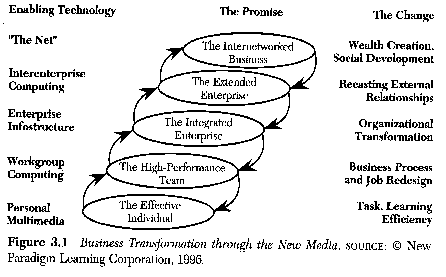
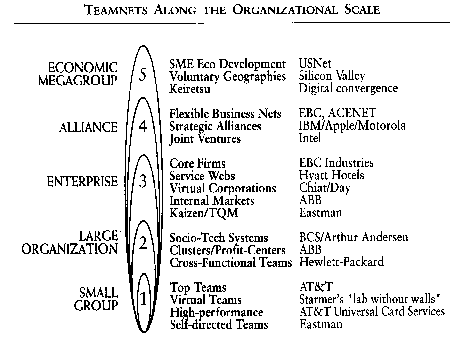
¶23 In this corporatist order, we recognize, the fundamental move is made when identity is from the first swallowed alive by the cult of the team (and thereafter, as Susan Albers Mohrman, et al., call it in their definitive work on the topic, the higher forms of the "team-based organization"). [34] What is a team? The positive answers offered by business are many and complex. In the terms I have developed here, the team is the unit of ephemeral identity that most flexibly fuses technologies and techniques into skill-sets (called "innovation," "creativity," "resourcefulness," etc.) adapted to the changefulness of the global economy. [35] But it is the negative answer that in our current context is most compelling: by definition a team is not an identity group, and it is assuredly not a class formation.
¶24 Or
rather, we must rethink the notion of negation at this point if we are
to avoid relapsing into once robust but now increasingly hapless modes
of posing social "hegemony" and class "oppression"Bthe oppositional (or dialectical) poses,
that is, of "them" versus "us" or big "company"
versus little "worker." By contrast, what is distinctively
new about contemporary corporate "identity management," as Thomas
B. Lifson calls it ("Innovation and Institutions," p. 315),
is that it does not so much master, marginalize, discriminate against,
or exclude group and class identities as takes them over complete
with their contestatory force (thus harnessing "diversity" to
"competitiveness") through that most powerful manner of postindustrial
negation: simulation. The team is designed from the ground up to "simulate
away" identity groups and class by incorporating identity groups
and class.
¶25 To understand how, we must now turn our gaze full upon the anti-historicism of business prophecy. As should be clear even from the brief views we have already had of it, this anti-historicism is so profound—yet often also so automatic and slick—that it might be likened to a shrink-wrapped, one-minute version of Alvin Toffler's Third Wave bundled together with Francis Fukuyama's The End of History and the Last Man. On the menu bar of each of the business bestsellers, as it were, there is a big button marked "Delete History." Thus witness the precision model of historical obsolescence offered by Maynard and Mehrtens's Fourth Wave:
¶26 The First Wave of change, the agricultural revolution, has essentially ended and will not be of concern here. The Second Wave, coincidental with industrialization, has covered much of the Earth and continues to spread, while a new, postindustrial Third Wave is gathering force in the modern industrial nations. We see a Fourth Wave following close upon the Third. (pp. 5-6)
¶27 The
possibility that the agricultural revolution may just now be reaching
broad expanses of the globe in complex collaboration with the industrial
revolution (tractors in Africa, for example) is moot: in this starkly
unlayered view of history the world is a diskette that can be reformatted
any number of times. Change, we heard in Chapter 2, means "starting
over," "the systematic sloughing off of yesterday." Hammer
and Champy add: it must be "fundamental," "radical,"
"dramatic" (pp. 32-33).
¶28 We might put the case in largest view as follows. Recall the succession of universalizing theories of civilization I earlier recited under the names of Reason, Repression, Instrumental Rationality, Knowledge/Power, and Knowledge Work. Contemporary management theory (descendant of the "managerial demiurge" C. Wright Mills identified in his classic study of the white-collar middle class) is the latest claimant in this Enlightenment genealogy. [36] As perhaps the most unmediated of anti-historicisms since the French Revolution (which presumed to throw out the relevant past to start over again in French Revolutionary Year One), management theory reveals with stark clarity that its universalism, progressivism, and rationalism resolve at base into a neo-Enlightenment theory of history. This theory (in a severe truncation of Fukuyama's thesis) holds that the only significant history is the end of history, or Reason. That end may be imagined at the teleological close to history, [37] but more ordinarily it is implanted as a sort of temporary telos in every point of significance in history. By this I mean that history in this view (and even in its counter-Enlightenment critique, as in Foucault) is finally all about "epochal," "revolutionary," or "epistemic" moments of change when history effectively starts anew—when it is historicity itself, in other words, that disappears from or, in the modern critique, becomes repressed in the "managed" apparatuses of Reason. Our greatest contemporary holdover from the Enlightenment, it might thus be said, is the belief that civilization is managed history. Whether one champions or critiques it, civilization simply is the faith that history can be rationally managed and that therefore, insofar as history from another point of view is precisely that which is unmanageable and irrational (Revolutionary mobs, the unconscious, Unreason, etc.), it must finally be managed through the overthrow/repression of history itself. ("Management is the organ of institutions," Drucker writes, "the organ that converts a mob into an organization, and human efforts into performance," Managing in Turbulent Times, p. 104. [38] ) The fact that much contemporary management theory in the Tom Peters mold appears to dance on the Bastille in its ludic celebration of "chaos" management and other forms of organizational irrationality is not an exception to the rule but instead the crowning instance of "the King is dead; long live the King!" (or its revolutionary variant, "the King is dead; long live the People!"). Irrationality in all its terrible energy is now to be harnessed within the organization as the very means of strong, rational management under the control of a charismatic leader (thus one of the outstanding contradictions of recent management theory: its simultaneous worship of decentralization and, often in a separate chapter, of executive "leadership"). [39] Postindustrial management is the ne plus ultra of the restructuring revolution initiated by the French Revolution with all its radical political, economic, geographical, calendrical, military, educational, and other reengineerings.
¶29 Now
we can understand why those immediate predecessors to academic subject
critique and cultural-class critique—so-called "essentialist"
identity politics and traditional Marxism, respectively—now seem so distinctly
unenlightened. These perspectives were predicated above all on remembering
the historical struggles of peoples and classes—even to the point that
the very process of "dispersing" identity (so phrased in subject-
and New-Class critique) was experienced historically as the saga of diaspora. [40] And by extension, we also
know what the postindustrial corporation must do to manage identity groups
and classes so thoroughly (in a constructionism that is the extreme of
subject and cultural-class critique) that it elides their last vestiges.
It has to hide their history. Just as the French Revolution attempted
to suppress the historical identity of estates and regions to ensure that
everyone high and low, Parisian and provincial, would be fraternal, in
other words, so now the new corporation does the same for subject-groups
and classes.
¶30 But
there is a difference. The French Revolution had substituted for historical
identity a representation of national identity that was first of all what
recent scholars of the period have called "theatrical" representation.
The new representative politics of the nation-state, in other words, was
theater before it was political reality, and one could only be fraternal
if one "performed" the role, complete with improvised clothes
and speech-forms, of citoyen.
[41] But postindustrial corporations substitute for historical identity
another style of unreal identity that makes even the post-historical or
"eternally modern" nation-state obsolete (and implies instead
the globalism that is now the necessary complement to any progressive
nationalism). In the postindustrial version of the local/general problem,
multinational corporations premise themselves solely on the local and
global, or intra- and international, to the exclusion of the nation-concept
in the middle, which now appears merely as a regulatory obstacle or trade
barrier. [42] The result
is that such corporations create a post-representational identity
that is not so much theater as what postmodern theorists call simulation. [43] Simulation is representation
backed up by no reality—or, what is the same, by "mass" realities
too simultaneously local and global for representations of nation-state
vintage to capture. On the side of consumption, for example, the pattern
was early on set by cable TV channels that reached out from local markets
(the city of Atlanta, for example) to blanket the world. And on the side
of production, the cellular unit of such corporate simulated identity
is the team. At once local and global, here at home and there in Japan,
teams are a fraternity that by-passes both the essential nation and, arising
to contest the melting-pot identity of such nation, essential group and
class formations.
¶31 To say that the team simulates away identity, then, reduces to saying that it deletes the historical identity of the folk's habitus (or, as the Birmingham Cultural Studies group termed it, customary corporation) and then preempts the recapture of that identity by the great political, economic, media, and other institutions of the nation-state era that had arisen specifically to manage that recapture—i.e., to modernize and bureaucratize the folk. [44] Identity is recaptured instead for a new "flexible" bureaucracy—the team-corporation—designed to forge no recognizable national, group, or class identification at all (no "our country/group/class: love it or leave it") but instead simulated identification with the team, simulated identification with all the higher organizational forms of the team-corporation we saw in the figures above (enterprise, alliance, megagroup, etc.), perhaps even simulated identification with global competition itself ("global competition: love it or leave it").
¶32 Consider, therefore, the recent fate of identity
groups and classes in the corporation. In regard to groups first, the
most instructive instance is U.S. diversity management. Diversity-management
theory arose in several works of 1991—most influentially, R. Roosevelt
Thomas, Jr.'s Beyond Race and Gender, David Jamieson and Julie
O'Mara's Managing Workforce 2000, and Marilyn Loden and Judy B.
Rosener's Workforce America!—and has since swollen into a whole
movement of studies, guidebooks, video series, training programs, and
corporate initiatives. [45] Prompted by the highly influential forecast of future
demographic diversity contained in the 1987 Hudson Institute report on
Workforce 2000, the movement explicitly discounts diversity efforts
driven by statutes redressing past discrimination. Instead, it
makes diversity all about present business self-interest. [46] To cite the subtitle of Gardenswartz and
Rowe's Diverse Teams at Work, it is about "capitalizing on
the power of diversity." Or as Roosevelt Thomas puts it: "Burning
the increasingly diverse human resource fuel" and unleashing the
"power that all the various groups in our national work force have
to offer" is "an opportunity for competitive advantage"
(pp. 9-10).
¶33 "Workforce 2000," in short, means that "Slavery Pre-1861," "Railroads Pre-1850," "Ellis Island 1892-1943," or "California 1990s" are not to the point—except (to put the pedal to Thomas's metaphor) insofar as their power may be drilled out of the historical ground, clarified of their dinosaur identities, and pumped into a corporate engine that had run on gas but now must guzzle any old diesel, methane, or perhaps even gasahol. Or rather, we cannot be content with mere bumper-sticker labels for history—part of the "Workforce 2000" mindset itself—if we are to be prepared to grasp the exact manner in which diversity management expends the past to compete in the present. What is the relevant history that is distilled out of the picture?
¶34 There
is too much detail here, of course. But the broadly historical intent
of the question will be served if we answer it this way: identity groups
as we now know them originally arose on the industrial-age "line"
or "shift" populated in different ways by emigrants from the
Old World to the New, the South to the North, and the country to the city.
[47] Previously, the identities of many of these migrants had been
rooted in agrarian-age work formations on the order of the yeoman "household"
(the extended family with or without live-in servants). [48] Together with its clan, village, parish, estate, and other
envelopments, such household culture was saturated with the kind of blood,
kin, religious, gender, language, paisan, and other solidarities
that would later be called "race," "ethnicity," and
so on. But crucially, such solidarities were not in themselves race,
ethnic, gender, or other constructs in our sense. Constructs of this
modern sort only became experientially real in dislocation from
their original location—i.e., in the diaspora that transplanted the household
onto the line/shift as a fragmented social system needing to be reconsolidated
in a new set of cultural formations in competition with those of other
diasporic groups. [49]
"Experientially real" in my phrasing here means that while dislocation
in fact derealized known cultural reality it was compensated for
by an abiding sense of history—a sense that the very process of reality-turning-unreal
(historical change) was a deeper reality cognate with identity. "Everything
we once knew is gone and we are as strangers in this land," history
says, "and therefore we are who we are."
¶35 The working subject, in other words, knew it was a subject only insofar as it was part of a "people" or "tribe" who, in a daily reenactment of their diaspora, all went on the line/shift together. This is why the Fordist-Taylorist line in its heyday was not just dehumanizing no matter how much it demanded that the lived reality of human technique mold itself to inhuman technology. The very fact of exile from one=s humanity simultaneously created the sense of a whole working-class neighborhood away from neighborhoodBa community so potentially solidaritous that it could have its own after-hours hangouts, charities, bowling leagues, youth subcultures, etc. (though cultural solidarity, we note, was effectively quarantined in "leisure"). [50]
¶36 We
now know how diversity management must proceed. Increasingly, it concentrates
on team-building or, in the now standard terminology, creating "diversity
teams." [51] For the team concept, of course, is the perfect way to deinstall
not so much the actual line/shift (U.S. auto makers, for instance, did
not adopt the Swedish innovation of station-based assembly
[52] ) as the relation between the worker and the line. Join
the team; leave your identity group and history behind to enlist in a
"small group culture" so semi-autonomous that it meets, talks,
works, and plays together and even has the celebrated power to "stop
the line." [53]
And once team culture is in place, then all the rest of downsizing culture
follows: smart work, flexible competence, flat management, and so on.
The general principle, in other words, is to couple diversity to the total
restructuring effort. Thus witness Thomas's restructuring of the "empowerment"
concept in Beyond Race and Gender:
¶37 Another word for the process of tapping employees' full potential is "empowerment". . . . In fact, a managing diversity capability is implicit in several innovations already in process in progressive organizations. Some corporations, for example, are moving to "push decision making down." Others are implementing "total quality" initiatives. Still others have downsized their work forces in search of greater efficiency and productivity. All of these initiatives, however they differ, have one aspect in common: Their success depends on the ability to empower the total work force. (10)
¶38 So, too, Carnevale and Stone assert that diversity simply corresponds point by point with "total quality management," "reengineering," and other major restructuring imperatives (pp. 116-18). The real work of achieving diversity, it is now believed, lies in achieving a proper team and corporate culture in the first place. [54]
¶39 The real work, we may thus say, is capitalizing the very concept of culture so that the pure business culture that remains at the end of the process becomes definitive of all culture. . . .
[The rest of this chapter is not included here.]
- Barrow, Clyde W. Universities and the Capitalist State: Corporate
Liberalism and the Reconstruction of American Higher Education, 1894-1928.
Madison, Wisconson: U. Wisconsin Press, 1990.
- Baudrillard, Jean. Simulations. Trans. Paul Foss, Paul Patton,
and Philip Beitchman. New York: Semiotext(e), 1983.
- Beverley, John. Against Literature. Minneapolis: Univ. of
Minnesota Press, 1993.
- Bloom, Harold. The Western Canon: The Books and School of the
Ages. New York: Riverhead, 1994.
- Business Week. "The New U.: A Tough Market is
Reshaping Colleges." 22 Dec. 1997: 96-102.
- _________. "Superstores, Megabooks—And
Humongous Headaches." 14 April 1997: 92-94.
- Carnevale, Anthony Patrick, and Susan Carol Stone. The American
Mosaic: An In-Depth Report on the Future of Diversity at Work.
New York: McGraw-Hill, 1995.
- Castells, Manuel. The Information Age: Economy, Society and Culture.
3 vols. (Malden, Mass.: Blackwell, 1996-97).
- Clarke, John, et al. "Subcultures, Cultures and Class."
In Stuart Hall and Tony Jefferson, ed., Resistance Through Rituals:
Youth Subcultures in Post-War Britain. London: Hutchinson / Centre
for Contemporary Cultural Studies, Univ. of Birmingham, 1976.
- Critical Art Ensemble. Home page. Retrieved 27 Dec. 1999. <http://www.critical-art.net/>.
- _________. Electronic Civil Disobedience and Other Unpopular
Ideas. Autonomedia, 1995. Retrieved in online form 27 Dec.
1999. <http://www.critical-art.net/ECD/ECD.html>.
- _________. The Electronic Disturbance. Autonomedia, 1994.
Retrieved in online form 27 Dec. 1999. <http://www.critical-art.net/ted/toc.html>.
- Davidow, William H., and Michael S. Malone. The Virtual Corporation:
Structuring and Revitalizing the Corporation for the 21st Century.
New York: HarperCollins, 1992.
- _________. Electronic Civil Disobedience and Other Unpopular
Ideas. Autonomedia, 1995. Retrieved in online form 27 Dec.
1999. <http://www.critical-art.net/ECD/ECD.html>.
- Dirlik, Arif. The Postcolonial Aura: Third World Criticism in the
Age of Global Capitalism. Boulder, CO: Westview, 1997.
- _________. "The Postmodernization of Production and
Its Organization. In his The Postcolonial Aura: Third World Criticism
in the Age of Global Capitalism.
- Donahue, Sean. "New Jobs for the New Economy." Business
2.0. July 1999. Retrieved 12 Dec. 1999. <http://www.business2.com/ebusiness/1999/07/19788.htm>.
[definition of "Ethical Hacker" at <http://www.business2.com/ebusiness/1999/07/19788-4.htm>]
- Drucker, Peter F. Managing in Turbulent Times. (New York:
Harper & Row, 1980)
- _________. Post-Capitalist Society. New York: HarperCollins,
1993.
- Dyson, Esther, George Gilder, George Keyworth, and Alvin Toffler.
"Cyberspace and the American Dream: A Magna Carta for the Knowledge
Age, Release 1.2" Progress and Freedom Foundation. 22 August
1994. Retrieved 22 May 2000. <http://www.pff.org/position.html>.
- Ehrenreich, Barbara, and John Ehrenreich. "The Professional-Managerial
Class." In Pat Walker, ed., Between Labor and Capital: The
Professional Managerial Class. Boston: South End, 1979.
- Electronic Disturbance Theater. "Electronic Civil Disobedience"
(Home page). Retrieved 27 June 2001. <http://www.thing.net/~rdom/ecd/ecd.html>
- Fukuyama, Francis. The End of History and the Last Man. New
York: Free Press, 1992.
- Fullerton, Jr., Howard N. "Labor Force Projections: The Baby
Boom Moves On." Outlook 1990-2005, Bureau of Labor Statistics,
U. S. Department of Labor, Bulletin 2402. Washington D. C., U. S. Government
Printing Office (May 1992): 29-42.
- Gardenswartz, Lee, and Anita Rowe. Diverse Teams at Work: Capitalizing
on the Power of Diversity. Chicago: Irwin, 1994.
- _________. Managing Diversity: A Complete Desk Reference and
Planning Guide. Burr Ridge, Illinois: Irwin, 1993.
- Geertz, Clifford. The Interpretation of Cultures: Selected Essays.
New York: Basic Books, 1973.
- Gibson, William. Neuromancer. New York: Ace Books, 1984.
- Gouldner, Alvin W. The Future of Intellectuals and the Rise of
the New Class: A Frame of Reference, Theses, Conjectures, Arguments,
and an Historical Perspective on the Role of Intellectuals and Intelligentsia
in the International Class Contest of the Modern Era. New York:
Seabury, 1979.
- Greenblatt, Stephen. Renaissance Self‑Fashioning: From More
to Shakespeare. Chicago: Univ. of Chicago Press, 1980.
- _________. Shakespearean Negotiations: The Circulation of Social
Energy in Renaissance England. Berkeley: Univ. of California Press,
1988.
- Griggs, Lewis Brown, and Lente-Louise Louw, ed. Valuing Diversity:
New Tools for a New Reality. New York: McGraw-Hill, 1995.
- Guillory, John. Cultural Capital: The Problem of Literary Canon
Formation. Chicago: Univ. of Chicago Press, 1993.
- Hammer, Michael, and James Champy. Reengineering the Corporation:
A Manifesto for Business Revolution. New York: HarperBusiness,
1993.
- Harris, Philip R., and Robert T. Moran. Managing Cultural Differences:
Leadership Strategies for a New World of Business. 4th ed. Houston,
Texas: Gulf Publishing, 1996.
- Hearn, Jeff, and Wendy Parkin. "Organizations, Multiple Oppressions
and Postmodernism." In John Hassard and Martin Parker, ed., Postmodernism
and Organizations. London: Sage, 1993.
- Hebdige, Dick. Subculture: The Meaning of Style. London:
Methuen, 1979.
- Huet, Marie‑Hélène. Rehearsing the Revolution: The Staging
of Marat's Death, 1793‑1797. Trans. Robert Hurley. Berkeley:
Univ. of California Press, 1982.
- Jamieson, David, and Julie O'Mara. Managing Workforce 2000: Gaining
the Diversity Advantage. San Francisco: Jossey-Bass, 1991.
- The Jargon File: A Comprehensive Compendium of Hacker Slang Illuminating
Many Aspects of Hackish Tradition, Folklore, and Humor. Current
editor: Eric Raymond. Retrieved 12 Dec. 1999. <http://www.tuxedo.org/~esr/jargon/jargon.html>.
- Johnston, William B., and Arnold H. Packer. Workforce 2000: Work
and Workers for the 21st Century. Prepared for the U. S. Department
of Labor. Indianapolis, Indiana: Hudson Institute, June 1987.
- Kellner, Douglas. "Intellectuals and New Technologies."
Media, Culture and Society 17 (1995): 427-48.
- Kernan, Alvin. The Death of Literature. New Haven: Yale Univ.
Press, 1990.
- Lauter, Paul. Canons and Contexts. New York: Oxford Univ.
Press, 1991.
- Lifson, Thomas B. "Innovation and Institutions: Notes on the
Japanese Paradigm." In Paul S. Adler. ed., Technology and the
Future of Work. New York: Oxford Univ. Press, 1992).
- Lipnack, Jessica, and Jeffrey Stamps. The Age of the Network:
Organizing Principles for the 21st Century. Essex Junction, Vermont:
Oliver Wight, 1994.
- Liu, Alan.
- "The Downsizing of Knowledge: Knowledge Work and Literary
History." Abridged version of Chap. 1 of The Future Literary,
with three responses to the paper. Ed. Randolf Starn. Doreen
B. Townsend Center Occasional Papers, No. 15. Berkeley, Calif.:
Townsend Center, 1998.
- _________. The Laws of Cool: The Culture of Information.
Forthcoming. Stanford Univ. Press.
- _________. "Local Transcendence: Cultural Criticism, Postmodernism,
and the Romanticism of Detail." Representations 32
(Fall 1990): 75-113.
- _________. Palinurus: The Academy and the Corporation—Teaching
the Humanities in a Restructured Age. Home page. U. California,
Santa Barbara. 2 May 2000. Retrieved 19 Oct. 2000. <http://palinurus.english.ucsb.edu>.
- _________. "The Power of Formalism: The New Historicism."
ELH 56 (1989): 721-71.
- _________. The Voice of the Shuttle: Web Site for Humanities
Research. Home page. 1 Nov. 2000. Retrieved 14 Nov. 2000.
<http://vos.ucsb.edu>.
- _________. "Wordsworth and Subversion, 1793‑1804."
Yale Journal of Criticism 2, no. 2 (Spring 1989): 55-100.
- _________. Wordsworth: The Sense of History. Stanford:
Stanford Univ. Press, 1989.
- "The Downsizing of Knowledge: Knowledge Work and Literary
History." Abridged version of Chap. 1 of The Future Literary,
with three responses to the paper. Ed. Randolf Starn. Doreen
B. Townsend Center Occasional Papers, No. 15. Berkeley, Calif.:
Townsend Center, 1998.
- Loden, Marilyn, and Judy B. Rosener. Workforce America! Managing
Employee Diversity as a Vital Resource. Homewood, Illinois: Business
One Irwin, 1991.
- Jean-François Lyotard. The Postmodern Condition: A Report on Knowledge.
Trans. Geoff Bennington and Brian Massumi. Minneapolis: Univ. of Minnesota
Press, 1984.
- Machlup, Fritz. The Production and Distribution of Knowledge in
the United States. Princeton: Princeton Univ. Press, 1962.
- Marcus, Greil. The Dustbin of History. Cambridge, Mass.:
Harvard Univ. Press, 1995.
- Maslan, Susan. "Resisting Representation: Theater and Democracy
in Revolutionary France." Representations 52 (Fall, 1995):
27-51.
- Maynard, Jr., Herman Bryant, and Susan E. Mehrtens. The Fourth
Wave: Business in the 21st Century. San Francisco: Berrett-Koehler,
1993.
- Micklethwait, John, and Adrian Wooldridge. The Witch Doctors:
Making Sense of the Management Gurus. New York: Random House, 1996.
- Miller, J. Hillis. Black Holes. Stanford, Calif.: Stanford
Univ. Press, 1999. (Published on the recto pages in a volume that contains
on the verso Manuel Asensi, J. Hillis Miller; or, Boustrophedonic
Reading.)
- Mills, C. Wright. White Collar: The American Middle Classes.
New York: Oxford Univ. Press, 1956.
- Mohrman, Susan Albers, Susan G. Cohen, and Allan M. Mohrman, Jr.
Designing Team-Based Organizations: New Forms for Knowledge Work.
San Francisco, Jossey-Bass, 1995.
- Montrose, Louis Adrian. "Renaissance Literary Studies and the
Subject of History." English Literary Renaissance 16 (1986):
5‑12.
- Negroponte, Nicholas. Being Digital. New York: Vintage /
Random House, 1995.
- Nelson, Cary. Will Teach for Food: American Labor in Crisis.
Minneapolis, MN: Univ. of Minnesota Press, 1997.
- Parker, Donn B. Fighting Computer Crime: A New Framework for Protecting
Information. New York: John Wiley & Sons, 1998.
- Parker, Mike, and Jane Slaughter. Choosing Sides: Unions and the
Team Concept. Detroit: Labor Notes / South End Press, 1988.
- Ransom, John Crowe, The New Criticism (Norfolk, Conn.: New
Directions, 1941)
- Readings, Bill. The University in Ruins. Cambridge, Mass.:
Harvard Univ. Press, 1996.
- Robins, Kevin, and Frank Webster. Times of the Technoculture:
From the Information Society to the Virtual Life. London: Routledge,
1999.
- Schumpeter, Joseph A.. Capitalism, Socialism and Democracy.
New York: Harper, 1975.
- Shimomura, Tsutomu, with John Markoff. Takedown: The Pursuit and
Capture of Kevin Mitnick, America's Most Wanted Computer Outlaw —
By the Man Who Did It. New York: Hyperion, 1996.
- Shklovsky, Victor. "Art as Technique." In Russian Formalist
Criticism: Four Essays. Trans. Lee T. Lemon and Marion J. Reis.
Lincoln, Neb.: Univ. of Nebraska Press, 1965.
- Shumar, Wesley. College for Sale: A Critique of the Commodification
of Higher Education. London: Falmer, 1997.
- Sproull, Lee, and Sara Kiesler. Connections: New Ways of Working
in the Networked Organization. Cambridge, MA: MIT Press, 1991.
- Steiner, Peter. Russian Formalism: A Metapoetics. Ithaca,
NY: Cornell Univ. Press, 1984.
- Sterling, Bruce. The Hacker Crackdown: Law and Disorder on the
Electronic Frontier. New York: Bantam, 1992. Also available online
from numerous sources, including versions with a Preface and Epilogue
added in 1994—e.g., <http://www.lysator.liu.se/etexts/hacker/>.
Retrieved 27 Dec. 1999.
- Tapscott, Don. The Digital Economy: Promise and Peril in the Age
of Networked Intelligence. New York: McGraw-Hill, 1996.
- Thomas, Jr., R. Roosevelt. Beyond Race and Gender: Unleashing
the Power of Your Total Work Force by Managing Diversity. New York:
AMACOM, 1991.
- Toffler, Alvin. The Third Wave. New York: Bantam, 1981.
- Unsworth, John, "Living Inside the (Operating) System: Community
in Virtual Reality." In Teresa Harrison and Timothy D. Stephen,
ed., Computer Networking and Scholarship in the 21st-Century University.
SUNY Press, 1996. Retrieved in online form 27 June 2001. <http://www.iath.virginia.edu/pmc/Virtual.Community.html>
- Watkins, Evan. Throwaways: Work Culture and Consumer Education.
Stanford, Calif.: Stanford Univ. Press, 1993.
- Workforce 2000: Work and Workers for the 21st Century. [see
under Johnston, William B.]
- Workplace: The Journal for Academic Labor. 15 Dec. 1999.
Retrieved 27 June 2001. <http://www.workplace-gsc.com/>.
- Wray, Stefan. "The Electronic Disturbance Theater and Electronic
Civil Disobedience." 17 June 1998. Retrieved 27 Dec. 1999. <http://www.nyu.edu/projects/wray/EDTECD.html>.
- _________. "On Electronic Civil Disobedience." 20-22 March
1998. Retrieved 27 Dec. 1999. <http://www.nyu.edu/projects/wray/oecd.html>.
[Note 1] . "The Death of Literature" is the title of Alvin Kernan's book, The Death of Literature (1990). Harold Bloom's best-selling The Western Canon: The Books and School of the Ages (1994), begins with "An Elegy for the Canon" and ends with an "Elegiac Conclusion." John Beverley's Against Literature (1993) takes aim at the cultural distinction of "literature" in Latin America to offer one of the most original and strident of many recent arguments against the category or status of literature. Beverley's discussion of the testimonio as a challenge to traditional literary genres and their encoded social distinctions may be taken as an epitome of the current turn against literature of "distinction" in favor of general literature. See p. 84: "What happens, then, when something like testimonio becomes literature? Does this involve a neutralization of its peculiar aesthetic-ideological effect, which depends, as we have seen, on its status outside accepted literary genres and norms?"
[Note 2] . Joseph A. Schumpeter, Capitalism, Socialism, and Democracy, pp. 84, 83.
[Note 3] . Ibid., p. 84; see also p. 32 on the foundational "turmoil" of capitalism.
[Note 4] . Peter F. Drucker, Post-Capitalist Society, p. 57; Manuel Castells, The Rise of the Network Society,Vol. 1 of The Information Age: Economy, Society and Culture, p. 199. (Subsequent references to Castells will be cited parenthetically). See also the Progress and Freedom Foundation's online manifesto titled "Cyberspace and the American Dream: A Magna Carta for the Knowledge Age" (discussed in Chap. 12). Thinking about business in the age of information, the "Magna Carta" takes it as a given that "dynamic competition—the essence of what Austrian economist Joseph Schumpeter called "creative destruction"—creates winners and losers on a massive scale."
[Note 5] . The quotation here is from Guillory=s Cultural Capital: The Problem of Literary Canon Formation, p. 166; subsequent references to this work will be cited parenthetically. For other comments in Guillory on the decline of the social status of literature, see for example pp. x, 81, 153. In his The Death of Literature, Kernan comments specifically about the decline of literature in the information age—e.g., "An informational model of social change would reveal . . . without concern for priority, that the photocopier, weak copyright, structuralist poetics, new-style democratic politics, and numerous other social energies are all 'saying' that texts are not so unique and particular as was once thought, or, more positively, that things of all kinds are much the same. In this new informational context, older views of copyright, originality, and artistic creativity would begin to lose plausibility and in time would simply disappear" (p. 127). Miller frames similar issues in the opening pages of his Black Holes, pp. 3-5: "Can literary study still be defended as a socially useful part of university research and teaching or is it just a vestigial remnant that will vanish as other media become more dominant in the new global society that is rapidly taking shape?" (Note: Miller's work is published on the recto pages of a volume whose verso pages contain Manuel Asensi's, J. Hillis Miller; or, Boustrophedonic Reading. Citations to Miller's work refer to the recto pages only.)
[Note 6] . In regard to Guillory=s concluding imagination in Cultural Capital of a universal afterlife of "aesthetics unbound," of aesthetics at the end of the class system, I invoke for comparison Milton's prophetic elegy, "Lycidas." "Lycidas," which mourns the death of Milton=s Cambridge friend, is in part also a work about the fate of intellectuals. It closes:
| Weep no more, woeful Shepherds weep
no more, For Lycidas your sorrow is not dead, Sunk though he be beneath the wat'ry floor. . . . . . . . . . . . Henceforth thou [Lycidas] art the Genius of the shore, In thy large recompense, and shalt be good To all that wander in that perilous flood. |
It does not demean Guillory's book, I think, to say that it is ultimately a "Lycidas" or prophetic elegy, and that, as in the case of all such elegies (readers not familiar with this genre will also want to read at least Percy Bysshe Shelley's "Adonais"), the mystery is how one gets from death to the moment of otherworldly release. Guillory, pp. 337-40, fills this rift between deadly, class-based aesthetics and the large recompense of "aestheticism unbound" with Marx and Bourdieu, whose ouevre he constructs as the very precedent for the rift. It is thus Bourdieu himself who utters "surprisingly 'utopian' statements" ( p. 339). But such a stopgap, perhaps, only defers the question, whose undergirding force is heard in Guillory's "surprise." What transitional aesthetics can bridge the rift between class-based and classless aesthetics? Or, in a less utopian voice, what aesthetics can represent itself to itself as transitional in this manner? The argument of my own ongoing research is that the answer inheres in the only avowed aesthetics of the techno-informatic New Class: "cool." Cool imagines itself to be what Guillory calls an aesthetics of "universal access" (p. 340), yet what such an aesthetics finally amounts to is the elitist imagination of a universal power to deny access (in the way that a truly cool, hip, slangy, or technically demanding Web page denies as much as it permits transparent access to information; see my argument about cool below). Cool is the missing transitional or paradoxical aesthetics in Guillory's scheme because it is a classless imagination of class or, put inversely, class-based imagination of classlessness.
[Note 7] . By focusing on producers of knowledge culture (researchers, teachers, professionals, managers, etc.) rather than their consumers (whether students in the academy or consumers in the mass market), I mean to give a view of the problem that complements the tradition of academic critiques of the "culture industry." Part of the argument my is that the most influential cultures in contemporary society are those of production rather than of consumption. I should also mention that in bifurcating knowledge work between, on the one hand, the academy and, on the other, the professional-managerial-technical stratum in the corporate, media, government, health, military, and other social sectors I do not mean on principle to elide the trade-press and journalistic workers (e.g., editors, publishers) who also play an important role in managing literature. In an era when major publishing and journalistic houses are increasingly subject to the management practices of their parent corporate aggregates, such literary managers occupy an uneasy hybrid zone between the academic and corporate realms that would be well worth a study in itself. (On the accelerating impact of postindustrial corporate philosophies on the book trade, including the imposition of "just-in-time" inventory management, see "Superstores, Megabooks—And Humongous Headaches," Business Week, April 14, 1997, pp. 92-94.)
[Note 8] . For my earlier reflections on cultural criticism, see especially: Wordsworth: The Sense of History (1989); "The Power of Formalism: The New Historicism" (1989); "Wordsworth and Subversion: Trying Cultural Criticism," (1989); and "Local Transcendence: Cultural Criticism, Postmodernism, and the Romanticism of Detail (1990).
[Note 9] . Arif Dirlik, "The Postmodernization of Production and Its Organization: Flexible Production, Work and Culture," in his The Postcolonial Aura: Third World Criticism in the Age of Global Capitalism, pp. 186-219. See also such essays in organization theory discussed by Dirlik as Robert Cooper and Gibson Burrell, "Modernism, Postmodernism and Organizational Analysis: An Introduction," Organization Studies 9/1(1988): 91-112; Kenneth J. Gergen, "Organization Theory in the Postmodern Era," in Michael Reed and Michael Hughes, ed., Rethinking Organization: New Directions in Organization Theory and Analysis (London: Sage, 1992): 207-226; and Jeff Hearn and Wendy Parkin,, "Organizations, Multiple Oppressions and Postmodernism," in John Hassard and Martin Parker, ed., Postmodernism and Organizations (London: Sage, 1993): 148-62. On a similar note, J. Hillis Miller comments, "Theory=s opponents lament the falsely supposed suspension of language=s referential function in 'deconstruction,' but that suspension actually characterizes the new global economy in all its features" (p. 47). (I am indebted to David Simpson for first steering me to Dirlik.)
[Note 10] . Cf., Douglas Kellner, "Intellectuals and New Technologies," p. 440: "In fact, the major research for two of my recent books was done from computer databases and I find that I am spending much more time in databases than in libraries for a variety of research projects. . . . Being an intellectual in the emerging high-tech societies thus requires new skills, the mastery of new technologies and intervention in new public spheres." On the cultural assumptions of operating systems, specifically Unix, see John Unsworth, "Living Inside the (Operating) System: Community in Virtual Reality" <http://www.iath.virginia.edu/pmc/Virtual.Community.html>, December 14, 1999. Unsworth's argument that "unlike transcendental fate, computer operating systems are historically and culturally determined" is conducted in the context of the Unix operating system.
[Note 11] . Stephen Greenblatt, Renaissance Self‑Fashioning: From More to Shakespeare, pp. 255-57.
[Note 12] . See my "The Power
of Formalism" on the affiliation of the New Historicism with formalism.
I use "formalism" here elastically to indicate the whole range
of criticisms spanning from Russian Formalism and New Criticism through
deconstruction that have had a lasting influence on how literary scholars
"read closely." The relation between the various close-reading
practices and the "technical" is clear even if antithetical.
Thus, for example, John Crowe Ransom's New Criticism, p. 299,
deploys a master diagram of the relation between poetic meaning and
sound that is exaggeratedly scientistic despite its overt purpose of
differentiating poetry from the determinate scientific meaning. The
diagram combines the iconography of textbook physics with that of set
theory (Venn diagrams) to make it seem that meaning and sound in poetry
propagate outwards according to the inverse square law. On technicality
and the New Criticism in general, see Miller, p. 65: "In place
of that [the traditional idea that literary study transmits a single
culture=s permanent values] the New
Criticism put, more or less in spite of itself, technical training in
the skills of 'close-reading.' Such skills were detached from any fixed
cultural values. . . . The New Critics asserted certain
universal cultural values while at the same time teaching an ahistorical
technologized form of reading antipathetic to those values."
Similarly,
the Russian Formalists approached literature as a matter of "devices"
and "techniques." A well-known example is Victor Shklovsky's
"Art as Technique." On Shklovsky's "obsession with
machine analogy" and the overall mechanistic emphasis of Russian
Formalism, see Peter Steiner, Russian Formalism: A Metapoetics,
pp. 44-67.
Finally,
on the relation between deconstruction and the technical, see Guillory's
discussion of the relation between "the avowed nonscience of rhetorical
reading and its transmission in the 'technical' form of a science"
(Cultural Capital, p. 201). "The refunctioning of rhetoric's
techne as a kind of technology," he argues, "directly
incorporated into the protocols of rhetorical reading a mimesis of the
technobureaucratic itself" (ibid., p. 262; see also pp.
181, 257, 262).
[Note 13] . On the corporate "universities," see John Micklethwait and Adrian Wooldridge, The Witch Doctors: Making Sense of the Management Gurus, p. 57, and William H. Davidow and Michael S. Malone, The Virtual Corporation: Structuring and Revitalizing the Corporation for the 21st Century, pp. 190-95.
[Note 14] . Davidow and Malone, p. 91. For my fuller discussion of contemporary corporate philosophy (including the "diversity management" movement), see "The Downsizing of Knowledge: Knowledge Work and Literary History," Doreen B. Townsend Center Occasional Papers, 15 (1998): 1-22. See also my Web site, Palinurus: The Academy and the Corporation — Teaching the Humanities in a Restructured Age, created in 1998, <http://palinurus.english.ucsb.edu>.
[Note 15] . This generalization, of course, does not apply to the same degree to all the humanities disciplines.
[Note 16] . In phrasing this problem in terms of past "metanarratives" of knowledge, I am influenced by Jean-François Lyotard=s, The Postmodern Condition: A Report on Knowledge, esp. pp. 31-37, and by Bill Readings, whom I cite below.
[Note 17] . Cf., Dirlik, Postmodern Aura, p. 3: "One of the fundamental contributions of postmodernism—indeed a defining feature of postmodernity—is the questioning of the teleology of the modern, and of other teleologies imbedded in economic, political and cultural narratives that have constituted the idea of the modern; so that it becomes possible once again to conceive the past not merely as a route to the present, but as a source of alternative historical trajectories that had to be suppressed so that the present could become a possibility."
[Note 18] . On the lack of modern enforcement powers underlying the image of power in Elizabethan times, see Stephen Greenblatt on "Queen Elizabeth, a ruler without a standing army, without a highly developed bureaucracy, without an extensive police force, a ruler whose power is constituted in theatrical celebrations of royal glory and theatrical violence visited upon the enemies of that glory"; Shakespearean Negotiations: The Circulation of Social Energy in Renaissance England, p. 64.
[Note 19] . Readers of Dirlik's The Postcolonial
Aura will recognize that my views on the function of history in
the age of postindustrial capitalism are broadly consonant with his—but
with a difference related to my specific goal of grasping the role of
aesthetics in such a context. One of Dirlik's main arguments is that
postmodern, cultural-critical notions of multiculturalism should be
replaced by a notion of "multi-historicalism" more aware of
the relation between culture and the structural conditions of global
capitalism. "In an ideological situation where the future has
been all but totally colonized by the ideology of capital," Dirlik
writes, "we can ill afford to overlook the critical perspectives
afforded by past alternatives that have been suppressed by the history
of capital. I take the recovery of these alternatives in memory to
be not regressive, but rather as a means to keeping alive alternative
visions of society that may yet open up the future in new ways"
(pp. 2-3). My difference with Dirlik pertains to his consistent disqualification
of postmodern cultural criticism (epitomized in "postcolonialism")
as a caretaker of the rain forest of alternative histories—a disqualification
that stems from its denial or ignorance of the structural conditions
of capitalism in favor of matters of representation and subjectivity.
Dirlik's understanding of postmodern cultural criticism does not accommodate
the fact—as I have suggested at length in my Wordsworth: The Sense
of History—that "denial" can itself be a powerful form
of historical expression or engagement (the concept of "denial"
is important both to Dirlik, e.g., p. 212, and to my "new historicist"
book on Wordsworth). Whether manifested as an act of imagination, fantasy,
the "bizarre" (Dirlik's most extreme denunciation of postmodern
cultural criticism, p. 212), or simple ignorance (which is not necessarily
an inert stance in the world of knowledge work), denial may—or may not
be—the same as withdrawal or disinterestedness. It depends on the particular
contest and context.
The
motive for my difference from Dirlik—with whom I am otherwise in profound
and multiple agreement—is to save a place at the table for art,
which has for some centuries diverged from an exclusive reliance on
the aesthetic ideology of mimesis (fidelity to natural or historical
reality). Especially since the onset of industrialism, literature and
art have been full of different kinds of denials of history. My question
in this essay concerns how the tradition of aesthetic denial might be
brought to bear on the condition of history in the postindustrial age.
It is for this reason that I take the especially aggressive form of
denial, imagination, fantasy, or bizarre behavior called hacking (see
below) to be a thought experiment in the art of the future. The idea
of the "other" fostered by cultural criticism in the academy,
as I see it, might yet be of service in educating the artist of knowledge—whether
avant-garde artist or humble Web-page designer in a cubicle—who
actively denies the historical necessity of postindustrialism.
[Note 20] . See Greil Marcus, The Dustbin of History, esp. pp. 3-28, for a plangent meditation on the topic of the obsolescence of the sense of history in contemporary times; see also Marcus's complaint against the "it's history" platitude, p. 22. (Cf., Louis Adrian Montrose, "Renaissance Literary Studies and the Subject of History," p. 11.) Evan Watkins Throwaways: Work Culture and Consumer Education is an insightful commentary on the culture of innovation and its antithetical other: obsolescence.
[Note 21] . On the period circa 1900, see Clyde W. Barrow's assessment in his Universities and the Capitalist State: Corporate Liberalism and the Reconstruction of American Higher Education, 1894-1928, esp. pp. 31-94, that the assimilation of the U.S. university system to the corporate form began in the 1890s. On the period from 1900 to 1930, see Alvin Gouldner's view that there was in these decades a "take-off period" in the demographics of a "New Class" that included both college faculty and the technical-professional-managerial intelligentsia (The Future of Intellectuals and the Rise of the New Class, p. 15). Gouldner's discussion here is based on occupational statistics studied in Barbara and John Ehrenreich's "The Professional Managerial Class," p. 19. (However, a study like the present focused on the circa 2000 period must also distinguish between the industrial and postindustrial epochs in the rise of the professional-managerial-technical New Class. Fritz Machlup observes that while the total period from 1900 to 1959 saw a massive rise in the numbers of knowledge workers led by clerical workers, whose numbers increased 1,002 percent, it was in the years 1940-59 that professional-managerial-technical knowledge workers led the way [The Production and Distribution of Knowledge in the United States, pp. 387-88].) On the post World War II era, see for example Lyotard's The Postmodern Condition.
[Note 22] . Miller=s more recent Black Holes (1998), which is dedicated to the memory of Readings, extends the lineage of inquiry that runs through these two works.
[Note 23] . "To put this another way, the appeal to excellence marks the fact that there is no longer any idea of the University, or rather that the idea has now lost all content. As a non-referential unit of value entirely internal to the system, excellence marks nothing more than the moment of technology=s self-reflection. All that the system requires is for activity to take place, and the empty notion of excellence refers to nothing other than the optimal input/output ratio in matters of information" (University in Ruins, p. 39).
[Note 24] . Bill Readings, The University in Ruins (1996).
[Note 25] . On the millenarism of recent times, see Castells, p. 4: "Bewildered by the scale and scope of historical change, culture and thinking in our time often embrace a new millenarism. Prophets of technology preach the new age, extrapolating to social trends and organization the barely understood logic of computers and DNA."
[Note 26] . Maintaining my academic Voice of the Shuttle web site <http://vos.ucsb.edu> since its origin in 1994, for example, has often meant justifying the protocols and vocabulary of academic knowledge to users from other occupational sectors who write to demand conceptual transparency or, more simply, just plain information. The scholarly or critical works indexed by VoS stand shoulder to shoulder with entertainment, commercial, corporate, journalistic, and other resources in an arena where all knowledge is viewed and judged within a single mental horizon called "browsing."
[Note 27] . My references here are to particular controversies.
On the uproar over plans (since dropped) to partner with major technology
companies in the California State University system, see the resources
gathered on one of the "Featured Controversy" Web pages on
my Palinurus
Web site: "Featured Controversy: California State University System
'Technology Infrastructure Initiative': Partnering for Knowledge,"
Palinurus: The Academy and the Corporation, 15 December 1999
<http://palinurus.english.ucsb.edu/CONTROVERSIES-2-calstate.html>.
On
the "Let=s
pretend we=re a corporation" philosophy and
restructuring plans of the President of the University of Florida at
Gainesville in 1997, see "The New U.: A Tough Market is Reshaping
Colleges," Business Week, Dec. 22, 1997: 96-102 ("English
professors must demonstrate, in essence, that Chaucer pays the bills
using funds as effectively as engineering or business classes").
On
the planned elimination of programs at George Mason University as the
university restructures for a technological future, see Victoria Benning,
"Liberal Arts at GMU Targeted by Degrees: Proposed Cuts Draw Immediate
Protests," March 15, 1998: B03.
On
the controversy (with international ramifications) that followed upon
the publication in September 1997 of the New Zealand government's Green
Paper on "A Future Tertiary Education Policy for New Zealand,"
see my online article on "The New Zealand 'Green Paper on a Future
Tertiary Education' and its Critics: A New Account of Knowledge,"
Palinurus: The Academy and the Corporation, 15 December 1999
<http://palinurus.english.ucsb.edu/CONTROVERSIES-1-New-Zealand.html>.
On
the general issue of the relation between higher education, corporatization,
and information technology, see my Palinurus:
The Academy and the Corporation Web site, esp. the set of bibliographies
on "Academe and Business" and "Information Tech and the
Academy" that are available through the "Suggested Readings"
link in the left-hand navigation frame of the site.
[Note 28] . Readings, University in Ruins; Miller, Black Holes; Paul Lauter, Canons and Contexts, esp. pp. 175‑97 on "Retrenchment—What the Managers are Doing"); Wesley Shumar, College for Sale: A Critique of the Commodification of Higher Education; Kevin Robins and Frank Webster, Times of the Technoculture: From the Information Society to the Virtual Life, pp. 168-218. For a more extensive bibliography of both scholarly and journalistic works dealing with the topic, see the "Academe and Business" section of the Suggested Readings bibliography on my Palinurus Web site.
[Note 29] . For essays from this point of view, see for example, Cary Nelson, ed., Will Teach for Food: American Labor in Crisis; see also Workplace: The Journal for Academic Labor <http://www.workplace-gsc.com/>. For a more extensive bibliography on this topic, see the "Suggested Readings" on my Palinurus Web site, esp. the page on "The Economics of Education" under the "Idea of the University" category," <http://palinurus.english.ucsb.edu/BIBLIO-UNIVERSITY-cost.html>.
[Note 30] . William Gibson, Neuromancer, p. 169: "You ever hear of slow virus before?" Dixie Flatline (McCoy Paulie), asks Gibson's protagonist, Case. "No." "I did, once. Just an idea, back then. But that's what ol' Kuang's all about. This ain't bore and inject, it's more like we interface with the ice so slow, the ice doesn't feel it. The face of the Kuang logics kinda sleazes up to the target and mutates, so it gets to be exactly like the ice fabric. Then we lock on and the main programs cut in, start talking circles 'round the logics in the ice. We go Siamese twin on 'em before they even get restless."
[Note 31] . The term "hacker" is used antithetically in the literature on computer hacking. In its original sense, "hacker" celebrated the pioneering, ingenious, up-all-hours, no-holds-barred, beyond-geek culture of computer academics and hobbyists—those who explored or jury-rigged systems as part of the normal course of their work because there were as yet no legitimate ways to accomplish a task or because the security stakes were low in a trust community of peers using systems designed to share rather than secure information. The term is still often used in this way by those in the computing community. Tsutomu Shimomura, for example (who came to fame for tracking down the computer criminal Kevin Mitnick), assertively uses "hacker" in this sense to contrast his boon tribe of computer security experts and other "wizards" with the shady computer "underground". On the other hand, a passage like the following in Shimomura indicates how uncannily the maverick sensibility of legitimate hackers resembles the dark side of the force:
| I've always found it a compelling intellectual challenge—finding the chinks in the armor of a computer or computer network that, unprotected, might enable a digital thief to loot a bank's electronic funds or permit foreign spies to slip into the Pentagon's computers. It's a world that you can't approach just on an academic or a theoretical level. You have to get your hands dirty. The only way you can know for sure the digital locks are strong enough is if you know how to take them apart and completely understand them. (ibid., p. 13; see also pp. 90, 97, 103) |
The general truth, perhaps, is that it is
the very mentality of analysis (as epitomized in contemporary
programmers who "know how to take them apart and completely understand
them") that verges antithetically into the zone of illegitimacy.
This is the zone where "hacker" has become associated with
stereotypically young, male, white, middle-class computer "gangs,"
braggadoccio hacker bulletin boards, and solo artistes with cipher-like
online names (sometimes descended from the older subculture of telecom
hacking or "phreaking"). For this use of the term, see for
example Donn B. Parker's Fighting Computer Crime and Bruce Sterling's
The Hacker Crackdown.
The
term "ethical hacking" is a late variant that mediates between
the two senses of "hacker" by envisioning an employable future
for illegitimate (and sometimes convicted) members of the computer underground.
A article by Sean Donahue in Business 2.0 titled "New Jobs
for the New Economy" defines "Ethical Hacker" as follows:
| It's the dream job for a generation of hackers: A company paying you to break into its network. By simulating attacks from the Net or from an internal source, ethical hackers locate weak spots in a company's network. Then they work with clients to prioritize which are the most serious threats, and suggest solutions. . . . Only the "ethical" part of the title is new. The best hackers . . . were illegally penetrating networks long before there was a market for that skill. . . . Salary: $60,000‑$140,000. |
In a related vein, the hacker's Jargon File explains the "hacker ethic" antithetically as follows:
|
1. The belief that information-sharing is a powerful positive good, and that it is an ethical duty of hackers to share their expertise by writing open-source and facilitating access to information and to computing resources wherever possible. 2. The belief that system-cracking for fun and exploration is ethically OK as long as the cracker commits no theft, vandalism, or breach of confidentiality. . . . . . . . . . . . . Sense 2 is more controversial: some people consider the act of cracking itself to be unethical, like breaking and entering. But the belief that "ethical" cracking excludes destruction at least moderates the behavior of people who see themselves as "benign" crackers (see also samurai). On this view, it may be one of the highest forms of hackerly courtesy to (a) break into a system, and then (b) explain to the sysop, preferably by email from a superuser account, exactly how it was done and how the hole can be plugged—acting as an unpaid (and unsolicited) tiger team. |
It
is important to note that the possibility of generalizing the role of
socially-constructive "ethical hacking" is still primarily
a hypothesis. I am uncomfortable taking up the cause of hacking as
a paradigm for a renewed creative arts and cultural criticism because
there are few clear models of ethical hackers (in the literal sense
defined above) and even fewer analogues in the artistic or cultural
critical communities. Such movements as the Critical
Art Ensemble and Electronic
Disturbance Theater (whose ethos resembles that of the 80's-era,
Bay Area Processed World collective) are candidates. But they
are perhaps too closely associated with anarchist, Situationist, radical
leftist, and/or high-theoretical paradigms (e.g., the "nomadism"
of Gilles Deleuze and Felix Guattari) to offer persuasive models for
an art that might affect the knowledge worker in his or her ordinary
cubicle. My hesitations aside, however, this is the direction that
the logic of my argument takes me, and so there I go. I cannot with
any honesty hold back from the conviction that hacking is the art of
the new millennium. The aesthetic vocabulary in the portion of Sterling's
Hacker Crackdown cited above is relevant: "Hacking can involve
the heartfelt conviction that beauty can be found in computers, that
the fine aesthetic in a perfect program can liberate the mind and spirit."
The
real issue, to which I have adverted, is how to differentiate between
hacking and terrorism.
[Note 32] . I discuss the Critical Art Ensemble and the Electronic Disturbance Theater in my concluding chapter.
[Note 34] . The book by Mohrman et al. may be called a "second-generation" work on teams that assumes that the case for team-working has aleady been made and that therefore the relevant problem is how to incorporate teams within the total structure of an enterprise. Cf., a work like Lee Sproull and Sara Kiesler=s Connections: New Ways of Working in the Networked Organization (1991), which simply declares as a given, "The fundamental unit of work in the modern organization is the group, not the individual" (p. 25).
[Note 35] . On teams, see in particular _____.
[Note 36] . C. Wright Mills, White Collar, pp. 77-111.
[Note 37] . In a manner not unrelated to the apocalyptic historiography of the very religion that the Enlightenment rejected.
[Note 38] . Micklethwait and Wooldridge, p. 77, comment on Peter Drucker=s general influence on management theory: "Perhaps Drucker=s most insightful observation is that management plays a vital role in all spheres of life, not just in business. It is as important for universities, churches, hospitals, or charities as it is for the manufacturers of soap powder. . . . management is not only a business concern; it is >the defining organ of all modern institutions.="
[Note 39] . On "postmodern" organizational theory as a means of control, see Dirlik, Postmodern Aura, pp. 202-210 and Jeff Hearn and Wendy Parkin, "Organizations, Multiple Oppressions and Postmodernism." See my Chap. 7 below for discussion of the way centralized forces of control can co-opt decentralization in networked information environments.
[Note 40] . This is not to say, of course, that subject critique in the constructivist mode was not also historical or at least new-"historicist" in orientation—a fact that will come into substantive play later in my argument. But historicism in the advanced cultural-critical modes are discontinuous rather than continuous with regard to the premise of identity: the past is appreciated in the intensity of its strangeness. Another way to put this is to say that constructionist historicism is by definition as much a questioning as endorsement of the foundation of history.
[Note 41] . See Susan Maslan, "Resisting Representation: Theater and Democracy in Revolutionary France," pp. 27-51; and Marie‑Hélène Huet, Rehearsing the Revolution: The Staging of Marat's Death, 1793‑1797.
[Note 42] . Nicholas Negroponte is quite succinct
on this topic in the section of his Being Digital titled, "The
Nation as a Mothball": "Nations today are the wrong size.
They are not small enough to be local and they are not large enough
to be global" (p. 238).
A
critique of the purely orthodox postindustrial thesis of globalization
would begin with Castells= assertion of the unacknowledged
importance of states in globalization: "the globalization thesis
ignores the persistence of the nation state and the crucial role of
government in influencing the structure and dynamics of the new economy"
(Information Age, I: 97). If we add his urgent discrimination
between "nation" and "nation-state" in the information
age (Information Age, II: 27-52), with the former apparent in
resurgent nationalisms, then it will appear that the notion of postindustrial
global economy radically undervalues the persistence of both "national"
and "nation-state" (or cultural and political) units of identity
in its imagination of a direct link between the local and global. (With
reference to the "imagined communities" thesis of nationhood,
it might be said, the local/global nexus is the postindustrial "imagined
non-community.") In Castells= overarching argument about
the resurgence of comunitarian identities at the local level (fundamentalisms,
nationalisms, etc.), the local is precisely not networked with the global,
and it is the nation/state concept in the middle that is the place to
look for the aporia between the two.
[Note 43] . Jean Baudrillard, Simulations.
[Note 44] . The line/shift was what the Birmingham School of cultural studies (referring to London working-class subcultures) calls customary "corporation": it had "its own corporate culture, its own forms of social relationship, its characteristic institutions, values, modes of life." John Clarke, et al., "Subcultures, Cultures and Class," p. 41. It is to be noted here that "customary" should not be broadened to the extent that it covers both industrial-age and agrarian-age folk cultures. The Birmingham School approach to subcultures (about which more in the next chapter) is all about specifically urban, industrial folk culture.
[Note 45] . Representative works: Lewis Brown Griggs and Lente-Louise Louw, ed., Valuing Diversity: New Tools for a New Reality; Katharine Esty, Richard Griffin, and Marcie Schorr Hirsch, Workplace Diversity; Lee Gardenswartz and Anita Rowe, Managing Diversity: A Complete Desk Reference and Planning Guide and Diverse Teams at Work: Capitalizing on the Power of Diversity; Anthony Patrick Carnevale and Susan Carol Stone, The American Mosaic: An In-Depth Report on the Future of Diversity at Work; and the sections on multiculturalism in Philip R. Harris and Robert T. Moran's standard textbook on global diversity titled Managing Cultural Differences: Leadership Strategies for a New World of Business. Carnevale and Stone recount the early genesis of diversity management, pp. 91-93. Diversity management, of course, has been very U. S.-centric. Carnevale and Stone, for example, discuss multiculturalism in other countries but conclude that the U.S. has the clear lead not only in perceiving "diversity" but in seeing it as a management opportunity (pp. 493-500). However, their conclusion is tempered by a recognition that analogous traditions of management in other countries (e.g., European adeptness at managing cross-national workforces) may only need to be readjusted to make the U.S. advantage disappear. On the international dimensions of multiculturalism, see also the chapter on "Managing Diversity in the Global Work Culture" in Harris and Moran.
[Note 46] . William B. Johnston and Arnold H. Packer's Workplace 2000: Work and Workers for the 21st Century was prepared for the U.S. Department of Labor in 1987. The findings of this report were later reinforced by U.S. Bureau of Labor Statistics forecasts. On the latter, see Howard N. Fullerton, Jr., "Labor Force Projections: The Baby Boom Moves On." See also Carnevale and Stone, pp. 40-44.
[Note 47] . This argument, of course, is necessarily a simplification based primarily on early-twentieth-century labor and immigration history. Fully to consider gender as well as later immigrant groups (e.g., sectors of the Latino work force), the notion of the "line" or "shift" would need to be broadened to give more emphasis to its inversion: the "home" separated from the line/shift. The domestic sphere (whether one's own or another's whose house or garden one tends) was also the locale where the experience of identity groups arose. But for convenience I will consider gender only as it was fashioned into an identity on the line/shift—in "women's" versus "men's" lines. (One of many vivid memories from my summers during college spent working on various factory lines and other menial jobs was the rigid distinction between women's assembly lines involving fleet finger-work and men's assembly lines involving mass-muscle work.)
[Note 49] . I am not assuming, of course, that populations in their original locale prior to migration were in steady-state, or that they did not often experience tensions resulting from long-standing histories of migrations and social collisions. For the purpose of my present argument, however, it is sufficient to simplify by taking the migration from pre-industrial to industrial society as our zero-point of origin.
[Note 50] . I am influenced in these thoughts by Dick Hebdige's Subculture, which sketches the intensely localized, working-class youth subcultures of London that emerged in a medium of leisure almost totally quarantined from the culture of work.
[Note 51] . See Carnevale and Stone, p. 117; Griggs and Louw, p. 114; Gardenswartz and Rowe, Diverse Teams at Work. See also Gardenswartz and Rowe's chapter on "Building Multicultural Work Teams" in their Managing Diversity.
[Note 52] . (Parker and Slaughter, p. 13).
[Note 53] . On "small group culture," see ___. On why the power to stop the line is infrequently used, see Parker and Slaugher, pp. __
[Note 54] . Dirlik observes, "What is of interest here is that transformations in management, required by changes in capitalism that were already under way, were blended with discussions of culture called forth by the need to manage a 'multicultural' work force, and reinforced the importance of culture in management" (Postmodern Aura, p. 194).
© Alan Liu, Dept. of English, Univ. of California, Santa Barbara (ayliu@humanitas.ucsb.edu)
The material on this page consists of draft matreials from The Laws of Cool: The Culture of Information (forthcoming, Stanford Univ. Press). Please do not reproduce without the author's permission. (Created online: 6/28/01)