Hypo-Semiosis (1)
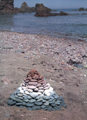
For all their orienting power, rock monuments were
hard signs. Being ponderous and place-bound, they could
not be used to convey information from place to place,
and though they were massive and could be monumental,
their capacity to convey information was slight. To
the uninitiated they say little more than, "Yes, there
is a message here;" while the bare or natural surroundings
seem to say, "No, there is no message elsewhere." Strictly
as a sign, a cairn and its surroundings constitute just
one bit of information. A cairn is not nearly as articulate
and explicit as the petroglyphs and pictographs of the
northern Rockies.
|
|
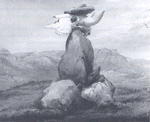
Karl
Bodmer, Antique Medicine Sign (1833)
Albert Borgmann, Holding
On to Reality: The Nature of Information at
the Turn of the Millennium
(Chicago: Univ. of Chicago Press, 1999), pp.
36-37
|
|
|
 The
something a cairn conveys arises from a particular
occasion, most eminently the appearance of the divine.
Since the informational capacity of the cairn is so
small, large tasks remain for the people to whom the
cairn is significant. Elaborate instruction and careful
memorizing are needed if the message of the sign is
to survive. Moreover, since the cairn as a sign is
occasion-bound as well as placebound, it normally
carries one and only one message. It is not a vessel
that can be used to convey different contents on different
occasions.
All this suggests why conventional signs developed
from the stationary and monumental to the mobile and
instrumental and so became better signs if lesser
things.
|
|
Hyper-Semiosis (1):
The Sublime
Thomas Weiskel, The Romantic Sublime: Studies in the Structure
and Psychology of Transcendence (Baltimore:
Johns Hopkins Univ. Press, 1976), pp. 23-24
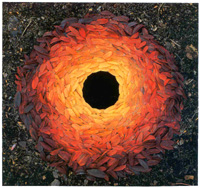 In
the second phase [of the sublime moment], the habitual relation
of mind and object suddenly breaks down. Surprise or astonishment
is the affective correlative, and there is an immediate
intuition of a disconcerting disproportion between inner
and outer. Either mind or object is suddenly in excess—and
then both are, since their relation has become radically
indeterminate. We are reading along and suddenly occurs
a text which exceeds comprehension, which seems to contain
a residue of signifier which finds no reflected signified
in our minds. Or a natural phenomenon catches us unprepared
and unable to grasp its scale. Any excess on the part of
the object cancels the representational efficacy of the
mind which can only turn, for its new object, to itself.
But self-consciousness, too, can be prior and can force
the rupture when the object (or memory) represented is too
insignificant (fails to signify). We think of prominent
examples in Wordsworth, for whom the object (often a memory)
is always in danger of precipitant attenuation.
 In
the third, or reactive, phase of the sublime moment, the
mind recovers the balance of outer and inner by constituting
a fresh relation between itself and the object such that
the very indeterminacy which erupted in phase two is taken
as symbolizing the mind's relation to a transcendent order.
This new relation has a "meta" character, which distinguishes
it from the homologous relation of habitual perception.
(In the case of poetic imagery, however, it is notoriously
difficult to draw a clear line between the image as perception
and as sign standing for the nonsensible or the unimaginable—a
fact that accounts for a history of quarrels over what is
or is not sublime.) Should there be a reversion to habitual
perception, the sublime moment subsides or collapses into
something else. For it is precisely the semiotic character
of the sublime moment which preserves the sublimation necessary
to the sublime.
|
| Hyper-Semiosis (2):
Simplon Pass, Again
William Wordsworth, The Prelude
(1850), VI.562-640
When from the Vallais we had turned, and clomb
Along the Simplon's steep and rugged road,
Following a band of muleteers, we reached
A halting-place, where all together took
Their noon-tide meal. Hastily rose our guide,
Leaving us at the board; awhile we lingered,
Then paced the beaten downward way that led
Right to a rough stream's edge, and there broke off;
The only track now visible was one
That from the torrent's further brink held forth
Conspicuous invitation to ascend
A lofty mountain. After brief delay
Crossing the unbridged stream, that road we took,
And clomb with eagerness, till anxious fears
Intruded, for we failed to overtake
Our comrades gone before. By fortunate chance,
While every moment added doubt to doubt,
A peasant met us, from whose mouth we learned
That to the spot which had perplexed us first
We must descend, and there should find the road, Which
in the stony channel of the stream
Lay a few steps, and then along its banks;
And, that our future course, all plain to sight,
Was downwards, with the current of that stream.
Loth to believe what we so grieved to hear,
For still we had hopes that pointed to the clouds,
We questioned him again, and yet again;
But every word that from the peasant's lips
Came in reply, translated by our feelings,
Ended in this,—that we had crossed the Alps.
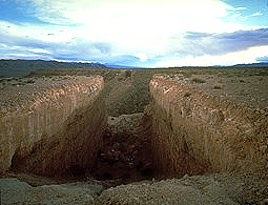
Imagination—here the Power so called
Through sad incompetence of human speech,
That awful Power rose from the mind's abyss
Like an unfathered vapour that enwraps,
At once, some lonely traveller. I was lost;
Halted without an effort to break through;
But to my conscious soul I now can say—
"I recognise thy glory:" in such strength
Of usurpation, when the light of sense
Goes out, but with a flash that has revealed
The invisible world, doth greatness make abode,
There harbours; whether we be young or old,
Our destiny, our being's heart and home,
Is with infinitude, and only there;
With hope it is, hope that can never die,
Effort, and expectation, and desire,
And something evermore about to be.
Under such banners militant, the soul
Seeks for no trophies, struggles for no spoils
That may attest her prowess, blest in thoughts
That are their own perfection and reward,
Strong in herself and in beatitude
That hides her, like the mighty flood of Nile
Poured from his fount of Abyssinian clouds
To fertilise the whole Egyptian plain.
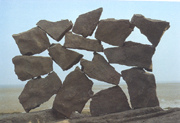
The melancholy slackening that ensued
Upon those tidings by the peasant given
Was soon dislodged. Downwards we hurried fast,
And, with the half-shaped road which we had missed,
Entered a narrow chasm. The brook and road
Were fellow-travellers in this gloomy strait,
And with them did we journey several hours
At a slow pace. The immeasurable height
Of woods decaying, never to be decayed,
The stationary blasts of waterfalls,
And in the narrow rent at every turn
Winds thwarting winds, bewildered and forlorn,
The torrents shooting from the clear blue sky,
The rocks that muttered close upon our ears,
Black drizzling crags that spake by the way-side
As if a voice were in them, the sick sight
And giddy prospect of the raving stream,
The unfettered clouds and region of the Heavens,
Tumult and peace, the darkness and the light—
Were all like workings of one mind, the features
Of the same face, blossoms upon one tree;
Characters of the great Apocalypse,
The types and symbols of Eternity,
Of first, and last, and midst, and without end. |
|
| Hypo-Semiosis (2):
Away from the Edge:
 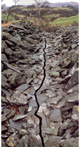 
From
"Interview
with Chris Drury," Fourth Door Review 2.3
(July 1998):
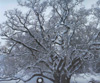
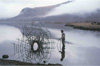
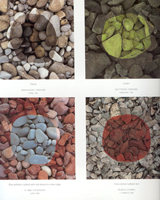
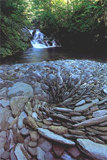 It's
as if the meaning is not in the work, for if I'm working
straight from here (the stomach) , there's no meaning in
the work, but the work is within a wider meaning. So the
meaning is not in the work—the work is in the meaning.
There's this South American tribe whose life revolves around
basket making. They do the same thing, in that there's no
particular meaning in the baskets they make, but the whole
way the baskets are made and woven, the collecting of materials,
fits into a wider meaning of their culture, within their
cosmology. They couldn't point to a basket, with, let's
say, geometrical designs on it and a frog in the middle,
and say it means this. It is the relation of designs in
a series of baskets that builds meaning within their cosmology.
But they couldn't actually say this basket means this—the
basket is just the beginning.
|
Toward a Theory of
Environmental Art (1):
"Sticky" Semiotics
Michel Foucault, The Order of Things: An Archaeology of
the Human Sciences
(New York: Vintage, 1973), p. 18
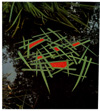 First
of all, convenientia. This word really denotes the
adjacency of places more strongly than it does similitude.
Those things are "convenient" which come sufficiently close
to one another to be in 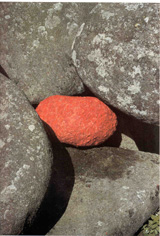 juxtaposition;
their edges touch, their fringes intermingle, the extremity
of the one also denotes the beginning of the other. In this
way, movement, influences, passions, and properties too, are
communicated. So that in this hinge between two things a resemblance
appears. A resemblance that becomes double as soon as one
attempts to unravel it: a resemblance of the place, the site
upon which nature has placed the two things, and  thus
a similitude of properties; for in this natural container,
the world, adjacency is not an exterior relation between things,
but the sign of a relationship, obscure though it may be.
. . . In the vast syntax of the world, the different beings
adjust  themselves
to one another; the plant communicates with the animal, the
earth with the sea, man with everything around him. Resemblance
imposes adjacencies that in their turn guarantee further resemblances.
Place and similitude become entangled: we see mosses growing
on the outsides of shells, plants in the antlers of stags,
a sort of grass on the faces of men. . . . All so many signs
of "convenience."
[Note: In Foucault's chapter on "The Prose of the World,"
convenience as explained above is the most fundamental
of four orders of representation, including also emulation,
analogy, and sympathy.] |
Toward a Theory of
Environmental Art (2):
"Fancy"
William Wordsworth, "A Whirl-Blast
From Behind the Hill" (composed 1798; included in "Poems
of the Fancy" in Poems 1815)
A WHIRL-BLAST from behind the hill
Rushed o'er the wood with startling sound;
Then—all at once the air was still,
And showers of hailstones pattered round.
Where leafless oaks towered high above,
I sat within an undergrove
Of tallest hollies, tall and green;
A fairer bower was never seen.
From year to year the spacious floor
With withered leaves is covered o'er,
And all the year the bower is green.
But see! where'er the hailstones drop
The withered leaves all skip and hop;
There's not a breeze—no breath of air—
Yet here, and there, and everywhere
Along the floor, beneath the shade
By those embowering hollies made,
The leaves in myriads jump and spring,
As if with pipes and music rare
Some Robin Good-fellow were there,
And all those leaves, in festive glee,
Were dancing to the minstrelsy. |
[Contrast:] From
Samuel Taylor Colerdige, "This Lime-Tree Bower My Prison"
(composed 1797), ll. 5-20:
They,
meanwhile,
Friends, whom I never more may meet again,
On springy heath, along the hill-top edge,
Wander in gladness, and wind down, perchance,
To that still roaring dell, of which I told;
The roaring dell, o'erwooded, narrow, deep,
And only speckled by the mid-day sun;
Where its slim trunk the ash from rock to rock
Flings arching like a bridge;—that branchless ash,
Unsunn'd and damp, whose few poor yellow leaves
Ne'er tremble in the gale, yet tremble still,
Fann'd by the water-fall! and there my friends
Behold the dark green file of long lank weeds,
That all at once (a most fantastic sight !)
Still nod and drip beneath the dripping edge
Of the blue clay-stone. |
|
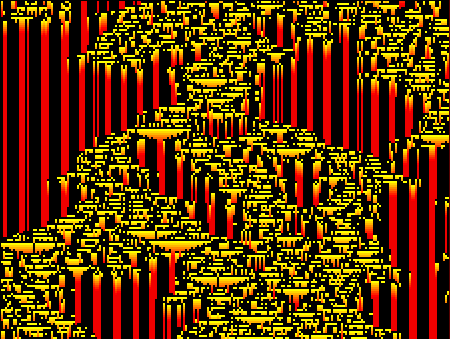
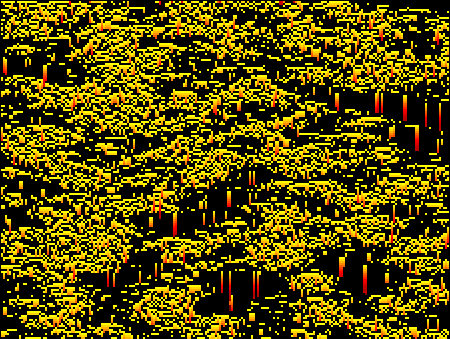
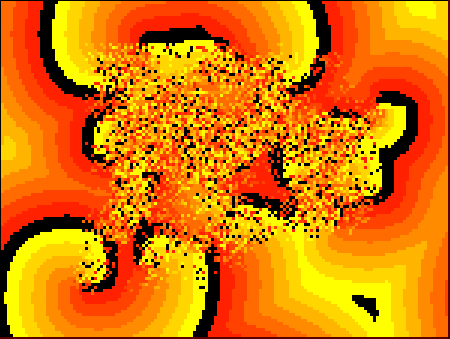
Toward a Theory of
Environmental Art (3): Cellular Automata
|
|